
You can often buy Bitcoin with a credit card or debit card, but only if the platform supports card purchases in your region, your account is verified, your card issuer allows the transaction, and you accept the fees and limits shown before confirmation.
That sentence is less exciting than "buy BTC instantly with a card."
It is also more useful.
A card purchase feels familiar because most of us already know the ritual: card number, billing address, security code, button. The confusing part is that a Bitcoin card purchase is not just a normal online checkout. It has at least four layers: the crypto platform, the card issuer, the payment network or processor, and the Bitcoin account or wallet where the BTC ends up.
If one layer says no, the purchase may fail. If one layer charges extra, the purchase may cost more than you expected. If the platform does not support withdrawals, buying BTC with a card may leave you with Bitcoin inside a platform account, not BTC you can send to your own wallet.
So the beginner goal is not to press the button quickly. The goal is to understand the button before it becomes expensive.

A card purchase can be convenient, but the review screen matters more than the button.
Can you buy Bitcoin with a credit card or debit card?
Yes, many crypto platforms and payment providers let eligible users buy Bitcoin with a credit card or debit card. The exact answer depends on your country, state, identity verification status, payment card type, card issuer, platform policy, and the current checkout flow.
For complete beginners, "Can I buy Bitcoin with a card?" really breaks into five questions:
Does the platform support BTC card purchases where I live?
Does the platform require identity verification before card purchases?
Does my card issuer allow crypto purchases?
What fees, spreads, limits, holds, or cash-advance treatment may apply?
After buying, can I withdraw BTC to a Bitcoin wallet if I choose to?
Do not skip the fifth question. A screen can say you bought Bitcoin while the BTC is still held inside a platform account. That may be fine for some beginners at first, but it is different from controlling Bitcoin in a self-custody wallet.
Also be careful with websites that advertise card purchases with skipped verification, no limits, no checks, or instant delivery before you have seen the real rules. Those promises are often where beginner mistakes gather in a little crowd.
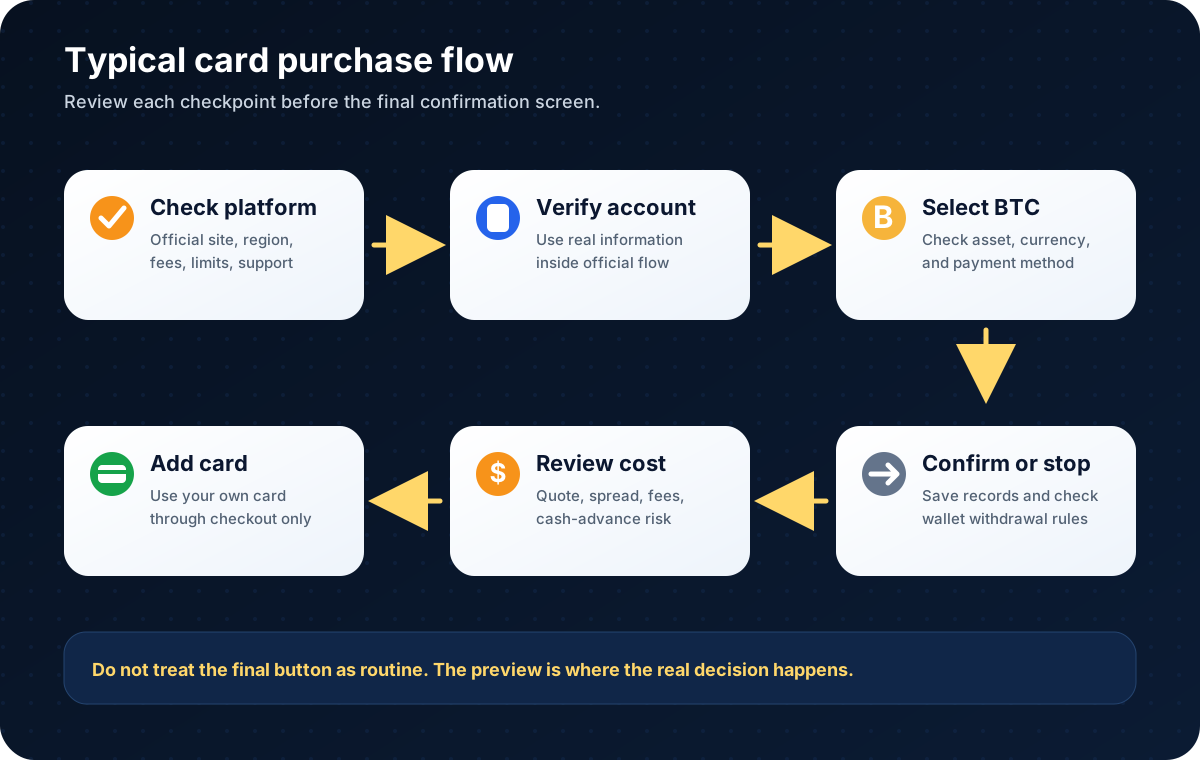
A card Bitcoin purchase has several checkpoints before confirmation.
Credit card vs debit card
A credit card and a debit card may look almost identical in your hand. In a Bitcoin checkout, they can behave very differently.
A debit card usually pulls money from your bank account or linked balance. If the purchase goes through, you are spending money you already have. That does not make it risk-free. You can still pay platform fees, card processing fees, spreads, foreign transaction fees, overdraft fees, and withdrawal fees later. Your bank may still block or review the transaction.
A credit card lets you borrow against a credit line. That adds another layer of risk. Some card issuers may block crypto purchases entirely. Others may treat certain crypto-related purchases as cash advances or cash-like transactions. A cash advance can carry separate fees, a higher APR, and interest that begins immediately. Promotional purchase APRs and rewards may not apply.
This is why "buy BTC with credit card" needs more caution than the phrase suggests. You are not only deciding whether to buy Bitcoin. You may also be deciding whether to borrow money to buy a volatile asset.
For a beginner, debit card purchases are often easier to reason about because the money leaves an existing balance. Credit card purchases need an extra pause: check the issuer's rules, cash advance terms, interest treatment, rewards exclusions, and your own ability to pay the bill in full.
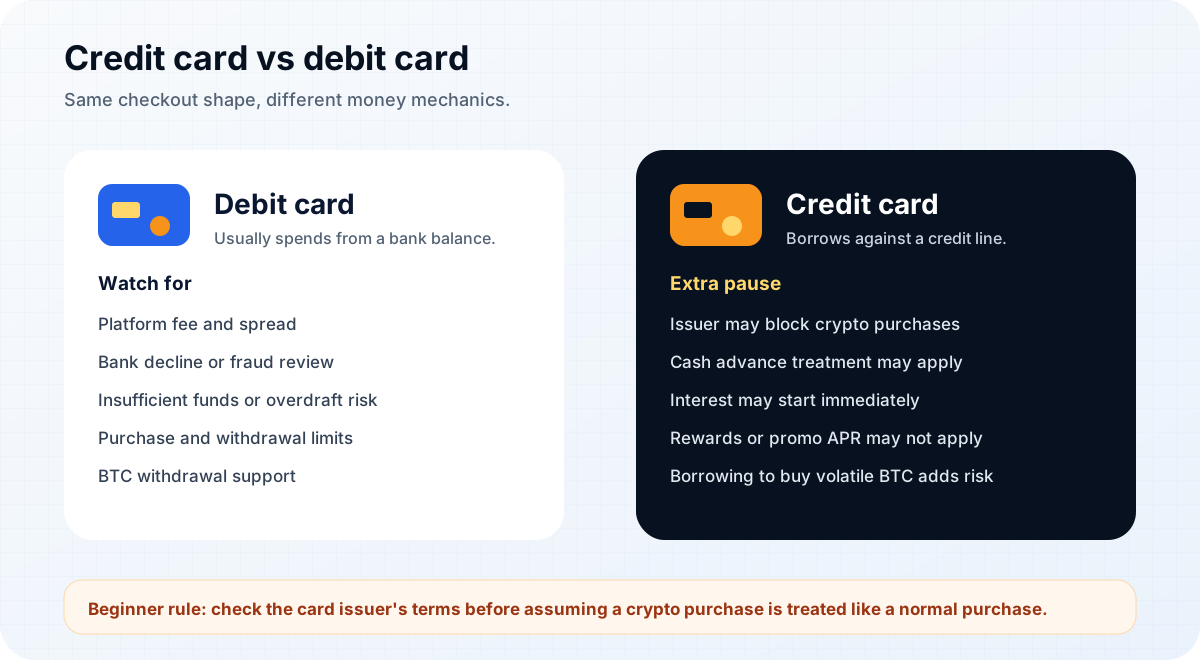
Debit cards and credit cards can trigger different costs, limits, and issuer decisions.
Typical card purchase flow
The exact screens change by platform, so do not treat any article or video as a permanent interface map. Before publishing or following a platform-specific tutorial, check the official interface, fees, limits, payment methods, and regional availability.
A normal card purchase flow looks like this:
Choose a legitimate platform that supports Bitcoin and card purchases in your region.
Create and verify your account if required. Use your real information and official platform flow. Do not try to bypass identity checks.
Open the buy screen and choose Bitcoin / BTC, not a similarly named asset.
Choose your payment currency such as USD, EUR, or GBP.
Select credit card or debit card if the option is available.
Enter card details only inside the official checkout flow or its approved payment processor.
Complete bank or 3D Secure approval if your card issuer asks for it.
Review the order preview for BTC amount, price, platform fee, spread, total charge, recurring buy settings, and any visible hold.
Confirm only if you understand the full cost and risk. If the screen feels confusing, stop.
Save your records after purchase and check whether the BTC is held on-platform or can be withdrawn to a wallet.
The important step is not step 9. It is step 8.
That is where the checkout stops being a smooth cartoon and becomes a financial decision.
If you are doing this for the first time, keep the learning amount small enough that a delay, fee, failed transaction, or confusing account hold does not become a serious problem. This is not a recommendation to buy Bitcoin. It is a way to avoid turning a lesson into a crisis.
Fees, cash-advance risk, and limits
Card buying is often convenient because the platform can quote and process the purchase quickly. Convenience can have a price.
When you buy bitcoin with credit card or debit card, the total cost may include:
A platform service fee
A card processing fee
A spread built into the quoted Bitcoin price
A foreign transaction fee from your card issuer
A cash advance fee or cash-like transaction fee from your credit card issuer
Interest if a credit card balance is treated as a cash advance or carried past the due date
A BTC withdrawal fee or Bitcoin network fee if you later move BTC to a wallet
Do not assume the fee shown in a headline is the total cost. The order preview matters, and your card issuer may have rules the crypto platform does not control.
Example: what a $100 credit-card quote can show
The fee list above can sound abstract until you see a real quote screen. In a June 2026 quote-only test, we used BitPay's buy-crypto flow to compare a 100 USD Bitcoin purchase with Credit Card selected as the payment method. The purchase was not completed; the screenshots only show the quote and order-detail screens available before confirmation.

On the BitPay offer screen, several providers returned different estimated BTC amounts for the same 100 USD payment:
Provider | Estimated BTC received for 100 USD | What this shows |
|---|---|---|
Banxa | 0.0015814 BTC | Best visible offer in this screenshot |
Sardine | 0.00156929 BTC | Slightly lower estimated BTC amount |
Simplex | 0.00153589 BTC | Another card offer in the same flow |
Ramp | 0.00150394 BTC | Lower estimated BTC amount |
MoonPay | 0.00149 BTC | Lower estimated BTC amount |
Transak | 0.0014622 BTC | Lowest visible offer in the package notes |
The useful lesson is not that one provider is always cheaper. It is that the same 100 USD card payment can produce different estimated BTC amounts in the same buying flow. In this example, the lowest visible offer delivered about 7.5% less BTC than the best visible offer, before considering any extra charge from the card issuer.
After selecting Transak, the provider quote refreshed slightly and showed an estimated receipt of 0.00146039 BTC. The quote page showed 100 USD paid, 0.00146039 BTC received, a reference rate of about 1 BTC = 63,811.68 USD, Card Payment as the payment method, and Inclusive of fees near the order details.

The Transak order details screen broke the 100 USD total into these visible components:
Fee item | Amount | Share of 100 USD total |
|---|---|---|
Cost of 0.00146039 BTC | 93.19 USD | 93.19% |
Transak fee | 5.39 USD | 5.39% |
BitPay fee | 1.15 USD | 1.15% |
Network/Exchange fee | 0.27 USD | 0.27% |
Total cost | 100.00 USD | 100.00% |
In this quote, the visible fees added up to 6.81 USD:
``text 5.39 USD + 1.15 USD + 0.27 USD = 6.81 USD ``
That means 93.19 USD of the 100 USD quote was shown as the BTC value, while 6.81 USD went to visible fees. Based on the estimated receipt of 0.00146039 BTC, the all-in effective price in this quote was about:
``text 100 USD / 0.00146039 BTC = 68,474.86 USD per BTC ``
This was higher than the reference rate displayed on the quote page because the final BTC amount reflected fees and quote mechanics. It does not mean every card purchase has the same fee, and it does not mean the provider is charging one single hidden fee. A card quote can include provider fees, platform fees, network or exchange costs, spread, and sometimes extra card-issuer charges that do not appear in the crypto checkout.
Treat this as a reading exercise for the order preview, not as a current BitPay or Transak fee schedule. Quotes can refresh quickly, providers can change, BTC prices move, and card issuer treatment can vary by country, card type, and bank. Before confirming any card purchase, compare the final BTC amount, visible fees, withdrawal rules, and your own card issuer's cash-advance or cash-like transaction rules.
Limits also vary. A platform may have minimum and maximum card purchase amounts. Your card may have a daily spending limit, fraud-control limit, cash advance limit, or available balance limit. A platform may hold withdrawals after a first card purchase for security reasons. The hold may apply to cash withdrawals, crypto withdrawals, or both, depending on the platform's current policy.
If you are using a credit card, check your card agreement before acting. The expensive mistake is assuming the transaction will be treated like a normal purchase when the issuer treats it as a cash advance or cash-like transaction.
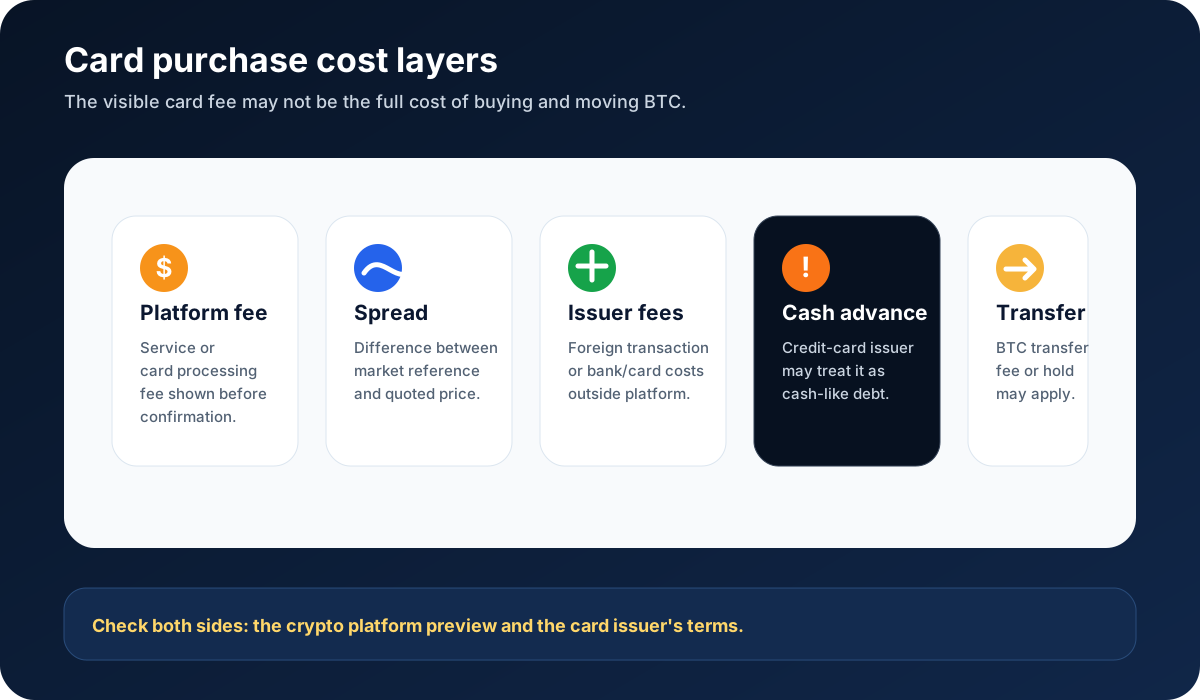
The card fee you see on the platform may not be the only cost.
Why card purchases fail
Card purchases fail for ordinary reasons and crypto-specific reasons. The failure message is often unhelpfully short, as if the machine became shy at the worst moment.
Common reasons include:
The platform does not support card purchases in your region.
Your identity verification is incomplete.
Your card name or billing address does not match the account.
The card issuer blocks crypto-related transactions.
The issuer requires 3D Secure or app approval that was not completed.
The card has insufficient funds, available credit, or spending limit.
The platform's card limit, weekly limit, or risk controls were reached.
The card type is not supported, such as certain prepaid, business, or virtual cards.
The price changed before the quote could be locked.
A browser, app, network, or processor issue interrupted the checkout.
The platform detected a VPN, unusual location, device change, or login risk.
If a card purchase fails, do not keep hammering the checkout button. Repeated failed attempts can create bank holds, duplicate pending authorizations, fraud alerts, or account reviews.
Use a calmer sequence:
Check whether the platform shows a clear reason.
Review your verification status, card details, billing address, and limits.
Check the official help center for supported cards and regions.
Contact your card issuer through the phone number or app listed by the issuer.
Wait for pending authorizations to clear before trying again.
Consider a bank transfer or another official payment method if the platform offers one.
Do not ask a stranger, social media account, or "support agent" in a chat group to fix the payment. Do not share card details, login codes, ID documents, seed phrases, or screen-sharing access.

A failed card purchase is a signal to check the rules, not to rush around them.
Alternatives to compare before using a card
A card is not the only way to purchase Bitcoin. It is just one path.
Card vs bank transfer: which payment method should beginners compare?
Before using a card, compare it with at least one lower-cost funding method. A card can be faster, but speed is only one part of the decision. Beginners should also compare total cost, issuer rules, waiting periods, withdrawal access, and the chance that a payment will be declined.
Payment method | Speed | Typical cost | Main risk | Better for |
|---|---|---|---|---|
Credit card | Fast | Often highest | Cash advance treatment, interest, issuer decline | Small, planned learning purchases when issuer terms are clear |
Debit card | Fast | Medium | Bank decline, card limits, overdraft settings | Simple beginner purchases using money already available |
ACH / bank transfer | Slower | Often lower | Waiting period, funding delay, withdrawal hold | Lower-cost buying when speed is not the main concern |
Cash App balance | Fast if funded | Varies | Platform limits, availability, withdrawal rules | Existing Cash App users who already understand the app's Bitcoin limits |
The beginner mistake is comparing only speed. A better comparison is: how much will this cost, when can I actually use or withdraw the BTC, and what rule could stop the transaction?
Some beginners compare card purchases with bank transfers, ACH, wire transfers, account balances, payment apps, or a platform's instant-buy feature funded by another method. These options can have different fees, timing, holds, limits, and verification requirements.
No option is always cheaper, faster, or safer. The better question is: which method gives you the clearest total cost and the least confusing path for your situation?
Card purchases may fit people who want a small learning purchase and understand the fees. Bank transfers may fit people who prefer to fund an account first and avoid credit-card borrowing risk, but transfers can still have delays, holds, and platform rules. Payment apps may feel simple, but they can have transfer limits and may not always support external Bitcoin withdrawals.
If your goal is self-custody, compare one more thing before buying: can the platform send BTC to a Bitcoin address? If yes, learn wallet safety before withdrawing. If no, understand that you may only have platform account exposure until you sell, transfer inside the platform, or use another supported route.
Risks, limits, and common misconceptions
The first misconception is that using a card means no verification. Many legitimate platforms require identity checks before card purchases. Do not use false information, another person's card, a borrowed account, a VPN to misrepresent your location, or edited documents to avoid KYC, tax, platform, or legal requirements.
The second misconception is that debit card purchases are always instant. A platform may quote quickly, but processing, verification, payment review, withdrawal holds, or account checks can delay access.
The third misconception is that credit card rewards make crypto purchases attractive. Some issuers exclude cash-like transactions from rewards. Some may treat crypto-related purchases as cash advances. Check the card issuer's current terms instead of guessing.
The fourth misconception is that buying Bitcoin with a card means you control the Bitcoin. You may control a platform account balance, not the private keys. If you later move BTC to a self-custody wallet, you must protect the recovery phrase offline and never share it. Losing or exposing the phrase can cause irreversible loss.
The fifth misconception is that a failed purchase means the platform is broken. Sometimes it means the issuer blocked the transaction, the card limit was reached, the region is unsupported, or the quote expired.
There is a useful way to think about card buying:
The card is the front door. The platform account is the hallway. A Bitcoin wallet is a separate room with a very unforgiving lock.
Do not confuse the rooms.
What to check before taking the next step
Before using a card, answer these questions:
Am I on the official website or official app?
Is Bitcoin / BTC selected?
Is the platform available in my region?
Is my account verification complete?
Does the platform accept my card type?
Does my card issuer allow crypto purchases?
Could this be treated as a cash advance or cash-like transaction?
What is the total charge shown on the order preview?
Is there a visible spread, card fee, platform fee, or withdrawal fee?
Are there purchase limits, withdrawal holds, or card issuer holds?
Is this a one-time purchase or recurring buy?
Can I withdraw BTC to a Bitcoin wallet later?
What records do I need for taxes and personal tracking?
What would make me stop?
That last question belongs on every beginner checklist. If the answer is "nothing," the card is not the problem. The plan is.
FAQ
Is it safe to buy Bitcoin with a credit card?
It can be possible to buy Bitcoin with a credit card on some platforms, but it is not risk-free. Check platform legitimacy, account verification, total fees, card issuer rules, cash-advance treatment, credit-card interest, and withdrawal access before acting. Do not borrow money you cannot repay to buy a volatile asset.
Can I buy Bitcoin with a debit card instantly?
Some platforms offer quick debit card purchases, but instant delivery is not something any article can promise. Verification, issuer approval, platform limits, payment review, price movement, or withdrawal holds can delay the process. Always check the current platform policy and final order preview.
Do card purchases require verification?
Many legitimate platforms require identity verification before card purchases, higher limits, withdrawals, or certain payment methods. Requirements vary by platform and region. Do not use false information or another person's account to bypass verification.
Can I buy Bitcoin with just a credit card?
Usually you need more than just the card. You may need a platform account, identity verification, a supported region, a card in your legal name, issuer approval, and 3D Secure or banking-app approval. The card is only one part of the flow.
What is the best website to buy Bitcoin with a credit card?
There is no single best website for every beginner. Compare official availability in your region, verification rules, fees, spreads, card issuer treatment, withdrawal support, security tools, records, and support quality. Avoid affiliate-style rankings that ignore your card issuer and local rules.
Can the IRS see your crypto wallet?
Public Bitcoin transactions are visible on the blockchain, but wallet ownership is not always obvious from an address alone. In the U.S., platforms may report certain digital asset activity, and taxpayers are responsible for accurate records and reporting. This article is not tax advice. Check current IRS guidance or speak with a qualified tax professional.
What if I invested $1000 in Bitcoin five years ago?
That is a hindsight calculator question, not a card-purchase safety question. Bitcoin's past price movement does not tell you whether a card purchase is suitable today. Focus on current risk, fees, issuer rules, taxes, and whether you can afford the loss.
Can I buy Bitcoin with a debit card and move it to my wallet?
Sometimes, but not always. You need a platform that supports BTC withdrawals, a completed account verification status, and no active withdrawal hold that blocks the transfer. Before withdrawing, learn Bitcoin wallet basics, address checking, network fees, confirmations, and recovery phrase safety.
Risk Disclaimer
This article is for beginner education only. It is not financial, investment, legal, tax, credit, or security advice. Bitcoin is volatile, and you can lose money. Card issuer rules, platform fees, spreads, limits, verification requirements, withdrawal support, regional availability, and tax treatment can change. Check the platform's current official policy and your card issuer's terms before acting.
Editorial Attribution
Written by Alex Chen. Reviewed by Jordan Blake for factual accuracy, clarity, and beginner safety.