
If a Bitcoin transaction is taking longer than expected, it may not be lost. It may be unconfirmed: broadcast to the network, visible by its transaction ID, and waiting in a node's mempool for possible inclusion in a block.
The short version is that block space is limited, new transactions arrive at changing rates, and miners generally have an economic reason to favor transactions with higher fee rates. The result is not a neat first-in, first-out line. It is a moving queue in which the apparent place of a transaction can change as new transactions arrive.

The mempool is a waiting area, not a promise: transactions compete for limited block space until one is included in a block.
That explains two beginner mysteries at once: why a wallet can show a real transaction that still has zero confirmations, and why the fee needed for a particular confirmation target can look different from one hour to the next.
What Is the Bitcoin Mempool?
The word mempool is short for memory pool. Bitcoin full nodes may keep valid, unconfirmed transactions in memory while those transactions wait to be included in a block.
There is an important detail hiding inside that sentence: there is not one official global mempool. Each node has its own view. Nodes can receive transactions in different orders, use different settings, restart, or remove low-fee transactions when their configured memory limit is reached. Two explorers can therefore show slightly different snapshots without either one being a master copy of “the mempool.”
For a beginner, the useful model has three stages:
Broadcast: a wallet or service sends a signed transaction to the Bitcoin peer-to-peer network.
Unconfirmed: nodes that accept it may hold and relay it while miners consider transactions for a block.
Confirmed: a miner includes it in a block that the network accepts. Later blocks increase its confirmation count.
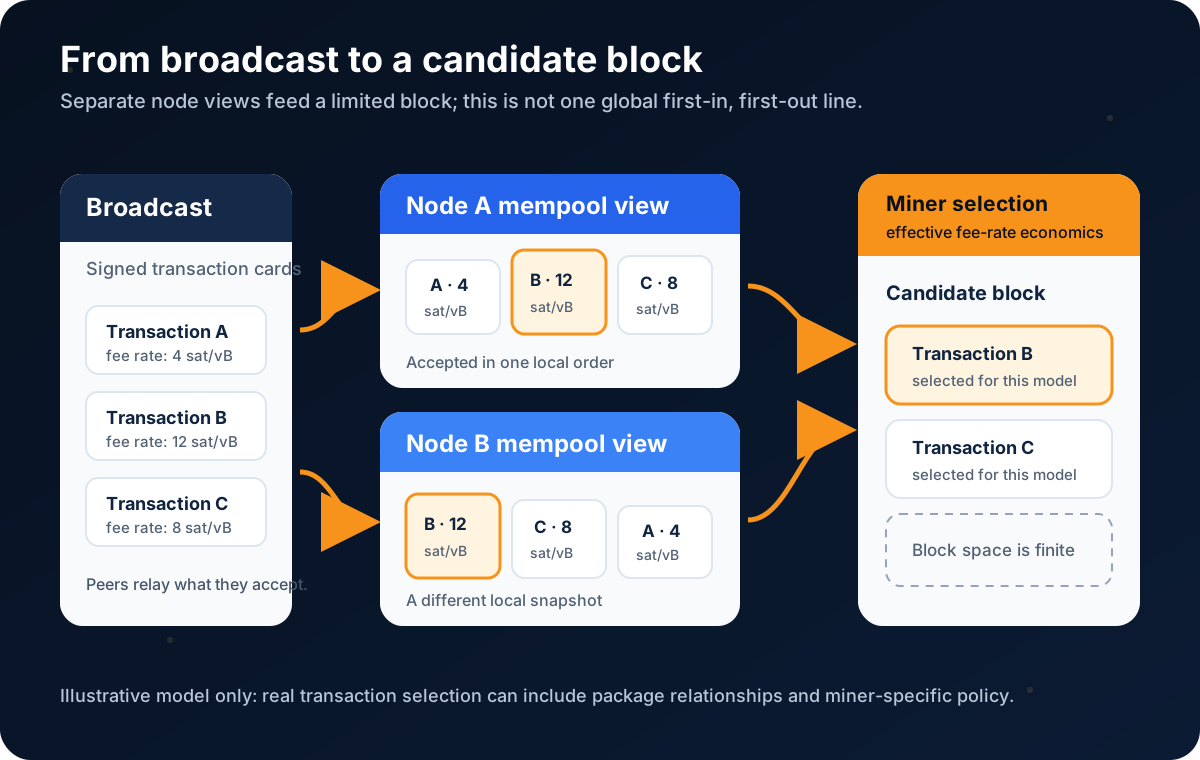
Nodes keep their own mempool views. Miners build candidate blocks from available transactions rather than following one universal arrival line.
A transaction being in a mempool does not make it final. Until it is confirmed, it can remain delayed, disappear from some nodes' mempools, or be replaced when the transaction and wallet support an applicable fee-bumping method. Do not treat an unconfirmed payment as irreversible settlement merely because it has a transaction ID.
Why Bitcoin Transaction Fees Change
A Bitcoin transaction fee pays for scarce block space. It is not a fixed percentage of the amount sent, and it is not set by one company for the entire network.
Network fee conditions change mainly because of four moving parts:
Demand for block space: when many transactions compete for near-term inclusion, higher-fee-rate transactions can crowd ahead of lower-fee-rate transactions.
Transaction size: a transaction with more inputs or outputs usually uses more virtual bytes and may need a larger total fee to reach the same fee rate as a smaller transaction.
Wallet estimation: wallets use their own data and confirmation targets to estimate a fee rate. Estimates can differ and can become stale as conditions change.
Node and miner policy: nodes decide which unconfirmed transactions they relay and retain, while miners decide what to include in candidate blocks subject to Bitcoin's rules and their own policies.
This is why “What are Bitcoin fees right now?” has no durable one-number answer. A useful estimate depends on the transaction's virtual size, the sender's desired confirmation target, the current transaction backlog, and the wallet or service actually creating the transaction.
Fee Rate vs. Total Fee
The easiest way to misunderstand Bitcoin fees is to look only at the total.
The total fee is the amount of bitcoin assigned to the miner fee by the transaction. At the transaction-data level, it is the value of the inputs minus the value of the outputs. Wallets normally calculate this automatically.
The fee rate compares that total fee with the transaction's virtual size. Explorers and wallets often show it in satoshis per virtual byte, written as sat/vB.
The beginner formula is:
fee rate = total fee ÷ virtual size
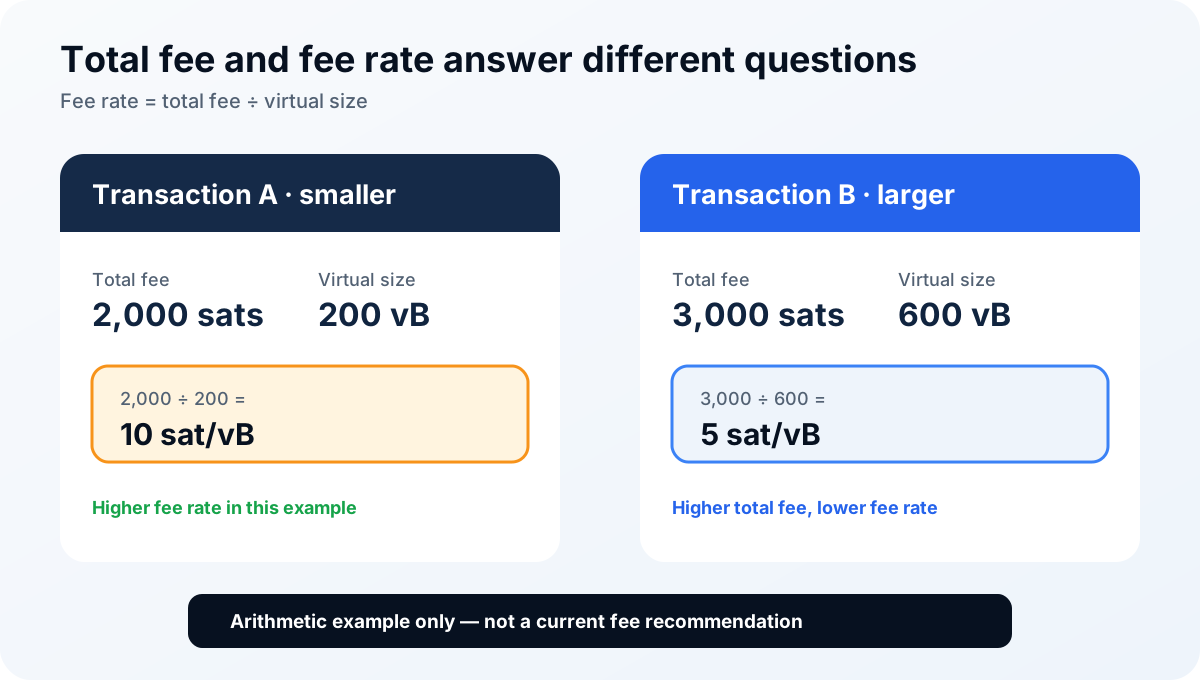
Miners compare transactions using fee-rate economics, so a larger transaction can pay more in total while still having a lower fee rate.
Imagine Transaction A pays 2,000 satoshis and uses 200 vB. Its fee rate is 10 sat/vB. Transaction B pays 3,000 satoshis but uses 600 vB. Its fee rate is 5 sat/vB. Transaction B pays more in total, yet Transaction A pays more for each unit of block space.
That example is only arithmetic, not a current fee recommendation. Do not copy its numbers into a real wallet. Check current conditions and let a reputable wallet estimate the actual transaction it is preparing.
How the Mempool Relates to Confirmations
An unconfirmed transaction has not yet been included in an accepted block. Once it is included, it has one confirmation. Each accepted block built after that increases the confirmation count.
Bitcoin does not promise that a transaction paying a particular fee will confirm in an exact number of minutes. Blocks do not arrive on a fixed appointment schedule, fee conditions can change after broadcast, and a miner's candidate block is not a reservation list.
Wallets, merchants, and exchanges can also apply different confirmation requirements before they show a deposit as available. A transaction can therefore be confirmed on-chain while the receiving service is still applying its own crediting process.
For more detail on timing, read How Long Does Bitcoin Take to Send?. To inspect a particular transaction, use the fields explained in our Blockchain Explorer guide.
Exchange Withdrawals Are a Separate Layer
When you withdraw Bitcoin from an exchange or another custodial platform, the platform—not you—may build and broadcast the on-chain transaction. This creates two different waiting rooms:
Platform processing: the withdrawal may be queued for identity, security, risk, liquidity, or batch processing before an on-chain transaction exists.
Bitcoin confirmation: after broadcast, the resulting transaction may wait unconfirmed in node mempools.
If the platform has not provided a Bitcoin transaction ID, a block explorer may have nothing to find yet. A status such as pending or processing inside the platform does not necessarily mean the transaction is already in the Bitcoin mempool.
Also distinguish the platform's withdrawal fee from the on-chain transaction's miner fee. A platform can set its customer fee according to its own policy, combine several withdrawals into one batched transaction, and choose the fee rate for that transaction. The amount charged to one customer may not equal the miner fee visible on-chain.
Platform interfaces, withdrawal fees, limits, identity checks, batching methods, confirmation policies, and regional availability can change. Use the platform's current official support information rather than assuming that a control shown in another wallet will exist there.
How to Check Fees Before Sending Bitcoin
You do not need to predict the next block. You need a short routine that separates facts from guesses.
Confirm the payment type. Make sure you are preparing an on-chain Bitcoin transaction, not a Lightning payment, internal platform transfer, test-network transaction, or another asset.
Check the wallet's estimate. Note the confirmation target or speed label, the estimated fee rate, and the total network fee for the actual transaction.
Compare current public conditions. A tool such as mempool.space can show a public view of the backlog, projected blocks, recent blocks, and suggested fee-rate tiers. Treat it as a guide, not a guarantee or a universal mempool.
Choose urgency honestly. If the payment is not time-sensitive, a slower target may cost less. If timing matters, do not assume a low-fee transaction can always be repaired later.
Check adjustment support before broadcast. Some wallets support Replace-by-Fee (RBF), Child Pays for Parent (CPFP), or another guided fee-bumping flow. Support and eligibility vary. Use only the wallet's official interface and instructions.
Review the non-fee details. Verify the destination address, network, amount, and any platform minimum. A sensible fee cannot repair a wrong address or wrong network.
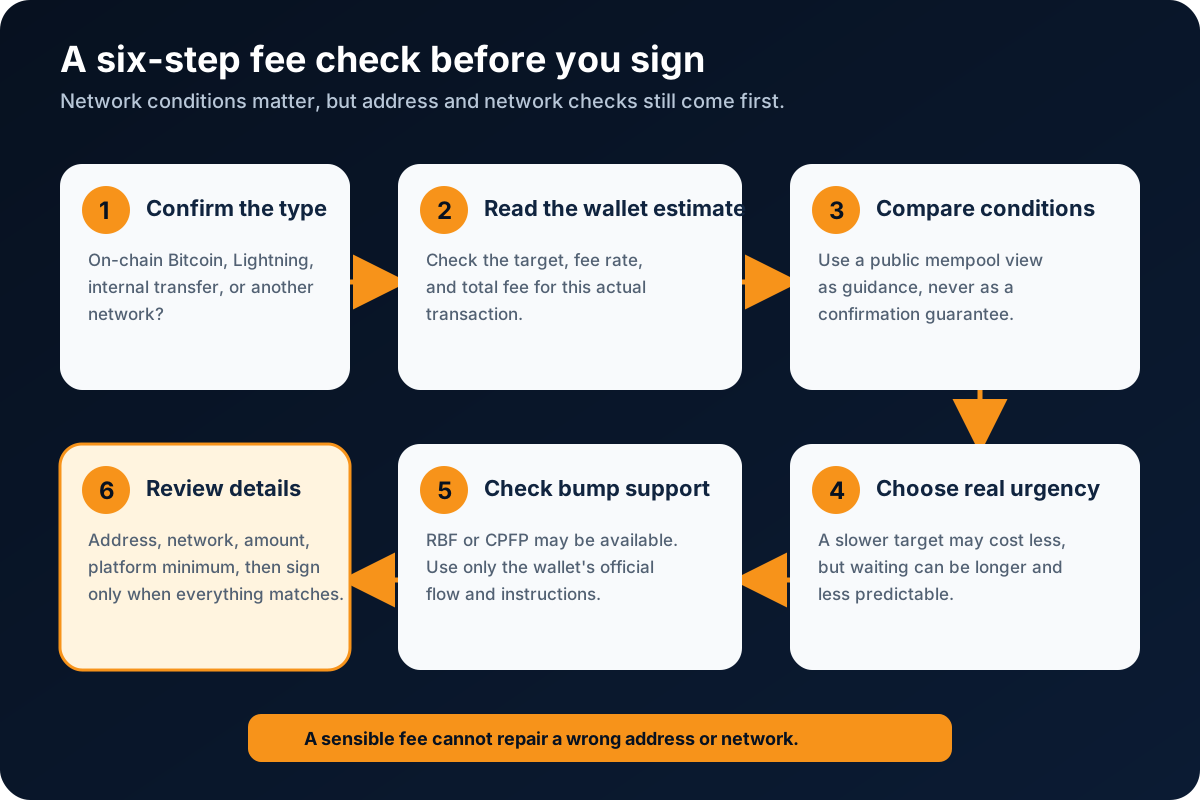
Check both the network estimate and the transaction details before signing. Fee selection is only one part of safe sending.
Our complete How to Send Bitcoin guide covers address and network checks. Bitcoin Fees and Minimums Before You Send explains why a platform minimum or withdrawal rule can matter even when the on-chain fee looks reasonable.
What mempool.space Can and Cannot Tell You
mempool.space is an open-source Bitcoin explorer that displays its view of unconfirmed transactions, projected blocks, fee-rate ranges, and recent blocks. You can also search a public transaction ID to inspect an unconfirmed transaction's fee rate and status.
It can help you answer practical questions:
Is the transaction visible to the explorer?
What fee rate does the transaction show?
How crowded do the projected blocks appear?
Have similarly priced transactions been confirming recently?
Has the transaction entered a block?
It cannot promise a confirmation time. Its suggested fee rates are estimates based on observed data, incoming transactions continue to change the queue, and other nodes may have different mempool views. Never enter a private key, seed phrase, recovery phrase, wallet password, or one-time code into an explorer. A public lookup needs only public information such as a transaction ID, block hash, or address.
When Waiting May Be Reasonable
Waiting can be reasonable when the transaction is valid and visible, the payment is not urgent, the fee rate is merely below current near-term estimates, and the recipient does not require immediate confirmation.
Before doing anything, save the transaction ID and check the wallet's current status. Do not create a second payment to the same recipient simply because the first one is slow. That can turn one delayed transaction into a duplicate-payment problem.
If timing matters, use the wallet's documented fee-management feature or contact the platform's official support channel. RBF and CPFP are technical mechanisms, not universal rescue buttons: the wallet, transaction structure, and current network policy all affect whether they are available. Do not send funds or reveal wallet secrets to a stranger offering to “unlock” a transaction.
If a transaction is not visible on reputable explorers, first determine whether it was actually broadcast and whether you are checking the correct network. A custodial withdrawal may still be inside the platform's processing system. A wallet may also display an updated transaction ID after a supported replacement.
FAQ
Why are Bitcoin fees high?
Bitcoin fees tend to rise when more transactions compete for limited block space. The total fee also depends on the transaction's virtual size, so a transaction with many inputs can cost more than a simpler transaction at the same fee rate. Wallet estimates, miner policies, and incoming transaction volume can change quickly.
Can I choose a lower fee?
Some self-custody wallets let you choose a slower confirmation target or set a custom fee rate. A lower fee rate can mean a longer or less predictable wait and, during heavy congestion, may fall below the relay or retention threshold of some nodes. Custodial platforms may not let users choose the on-chain fee rate. Check the wallet or platform's current official controls before signing.
What is mempool.space?
mempool.space is an open-source Bitcoin block explorer and mempool visualizer. It shows a public view of unconfirmed transactions, projected blocks, recent blocks, and fee-rate estimates. Its data is useful for orientation, but it is not the one official mempool and its estimates do not guarantee confirmation within a specific time.
Does a higher fee guarantee instant confirmation?
No. A higher effective fee rate can improve a transaction's economic priority relative to other available transactions, but it does not reserve a place in the next block. Block timing, new transaction arrivals, package relationships, miner policy, and transaction validity still matter.
Risk Disclaimer
This article is for general education, not investment, legal, tax, or cybersecurity advice. Bitcoin transactions may be irreversible after broadcast and confirmation. Verify the destination address, amount, network, fee, and current transaction status before signing or relying on a payment. Never share a private key, seed phrase, recovery phrase, wallet backup, password, or one-time code with an explorer, support contact, or fee-acceleration service. Keep recovery phrases backed up offline according to the wallet's official instructions; losing the only valid backup can cause permanent loss of access. Wallet and platform interfaces, fees, limits, identity checks, confirmation policies, withdrawal rules, and regional availability can change, so verify current official policies before acting. Keep appropriate records and check local tax requirements when sending, receiving, selling, or cashing out Bitcoin.
Editorial Attribution
Written by Alex Chen. Reviewed by Jordan Blake for factual accuracy, clarity, and beginner safety.