
How long does Bitcoin take to send? The honest answer is: it varies.
A Bitcoin transaction can appear quickly, stay pending for a while, gain confirmations over time, and still wait on a wallet or platform before the recipient sees it as credited.
That makes Bitcoin waiting feel stranger than ordinary online payments. With a card payment, you mostly stare at one clock. With Bitcoin, there are at least three clocks on the wall: the network clock, the platform clock, and the tiny panic clock inside the beginner's head.
Only one of those clocks gets louder when you refresh the page.

Bitcoin send time depends on more than one clock.
The short answer: Bitcoin send time varies
Bitcoin send time depends on several things at once:
Whether the transaction was broadcast.
Whether it is still pending or unconfirmed.
Whether it has been included in a block.
How many confirmations the receiver or platform requires.
Whether the fee and current network conditions make confirmation slower or faster.
Whether a platform has extra processing or deposit-crediting rules.
So if you are asking "how long does it take to send Bitcoin?" the safer beginner answer is not a single number. The safer answer is a status check.
Has the transaction appeared? Is it unconfirmed? Does it have confirmations? Has the receiving wallet or platform credited it yet?
Those are different questions. Mixing them together is how a normal wait turns into a small emotional weather event.
If you are still preparing to send, the actual send flow matters before the waiting clock does. For the wider route, keep the send-and-sell path separate from this timing question.
Pending, unconfirmed, and confirmed
Beginner panic often starts with one word: pending.
Pending usually means the transaction has not yet reached the status expected by the wallet, platform, or service you are looking at. Unconfirmed usually means the transaction has not yet gained the confirmation state that would make it more settled. Confirmed means it has been included in a block and has begun accumulating confirmations.
The exact wording can vary by wallet or platform, which is annoying because money is involved and software vocabulary apparently enjoys drama.
Still, the basic shape is simple:
Status word | Beginner meaning | What not to assume |
|---|---|---|
Pending | The action is still waiting somewhere in the process | It does not automatically mean the Bitcoin is lost |
Unconfirmed | The transaction has not reached the expected confirmation state | It does not automatically mean you should click random "recover" links |
Confirmed | The transaction has been included in a block and has confirmations | It does not always mean a platform has credited it yet |
Credited | A wallet or platform has recognized the deposit according to its own rules | It may happen after the on-chain confirmation step |
If you have a transaction ID, a block explorer can help you check public status without touching private wallet information.
The explorer can help you read public status. It cannot calm your nervous system, cancel the transaction, or make a platform credit faster.
Which is unfortunate.
But useful to know.
How confirmations work
A Bitcoin confirmation is connected to blocks.
In beginner terms, a transaction becomes more settled when it is included in a block and more blocks are added after it. If your transaction is in the newest block, it has started the confirmation path. As more blocks follow, the confirmation count grows.
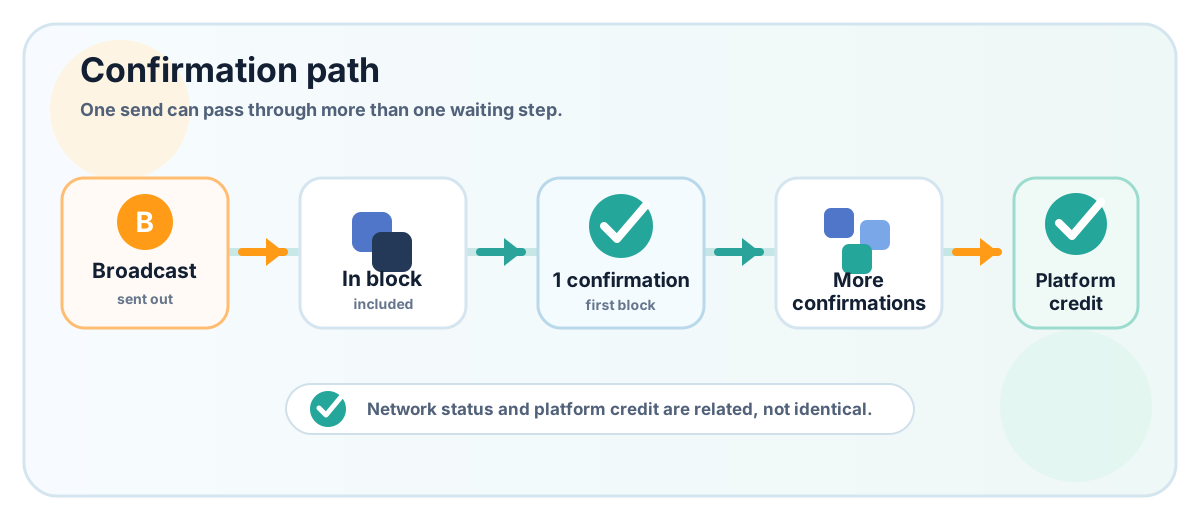
Confirmations help wallets and platforms decide when a transaction is settled enough.
This is why people talk about "Bitcoin confirmations" when they talk about send time. They are not just counting minutes. They are counting how much blockchain history has been added after the transaction.
The common mistake is treating confirmations like a universal stamp:
"One confirmation means done."
"Three confirmations means done."
"Six confirmations means done."
Those numbers can matter in different contexts, but there is no single beginner rule that fits every wallet, platform, amount, or risk policy. A small personal transfer and a large platform deposit may not be treated the same way.
The useful question is:
How many confirmations does this receiving wallet or platform require for this action?
That answer belongs to the receiver's current rules, not to a random forum comment from four years ago.
Why wallets and platforms wait for different confirmation counts
A Bitcoin transaction can have confirmations while a platform still says the deposit is pending.
That sounds contradictory until you separate the two clocks.
The Bitcoin network clock asks: has this transaction been included in blocks?
The platform clock asks: has this service decided that the transaction meets its crediting rules?
Those are related, but they are not the same. A platform may wait for a certain confirmation count, run extra internal checks, batch updates, delay crediting, or apply rules based on amount, account status, region, or risk controls.
The public blockchain does not know your platform account. The platform account does not become instant just because you can see public confirmations.
So if an explorer shows confirmations but your platform still shows waiting, do not assume the explorer is wrong. Also do not assume the platform is broken. Check the receiving platform's current deposit or withdrawal guidance.
When the destination path looks suspicious, the next question is whether this is a wrong Bitcoin network problem. When the uncertainty is the receiving string itself, treat it as an address check, not a speed problem.
Fees, network conditions, and platform processing
Fees can affect how quickly a Bitcoin transaction is likely to be included, especially when many transactions are competing for block space. But fee language can get messy because wallets and platforms may describe fees, estimates, priority, or processing in different ways.
The beginner version:
A transaction needs to be broadcast.
It waits to be included in a block.
Fees and network demand can affect that waiting process.
After block inclusion, confirmations accumulate.
A platform may still wait before crediting the account.
This does not mean you should chase random "accelerator" pages or trust a stranger who says they can speed up your transaction for a fee. Some wallets have legitimate fee or replacement features. Some platforms have official support flows. A lot of the internet also has excellent costumes.
Use the wallet or platform's official guidance.
If your main problem is the amount that finally arrives, the timing question has crossed into fees and minimums, which is a separate check.
What to check before you panic
If Bitcoin has not arrived, the first job is not to click faster. It is to separate facts from fear.
Use this order:
Check | What it tells you | Beginner caution |
|---|---|---|
Transaction ID | Whether a transaction was broadcast and can be looked up | Do not share private keys or seed phrases |
Explorer status | Pending, unconfirmed, or confirmed state | Explorer cannot recover funds |
Confirmation count | How many blocks have followed the transaction | Required count depends on receiver or platform |
Network/address | Whether you used the intended path and destination | Wrong-path or wrong-address issues may not be recoverable |
Receiving platform policy | When the platform credits deposits | Platform processing can differ from chain status |
Official support channel | Where to ask if the platform is involved | Avoid private-message "support" and recovery offers |
The table is not a rescue spell. It is a way to avoid making the second mistake.
Do not post your seed phrase. Do not send your private key. Do not share a login code. Do not type wallet recovery words into a form that says it can "verify" the transaction.
If the transfer involves meaningful money and the situation is unclear, stop and use official wallet or platform documentation. If needed, seek qualified help.
FAQ
Can Bitcoin take 24 hours to send?
It can happen that a Bitcoin transaction or platform crediting process takes much longer than a beginner expected. The cause may be confirmation status, fee conditions, wallet behavior, platform processing, or the receiver's own rules. Check the txid, confirmations, and official platform guidance before taking another action.
Why is my Bitcoin transaction pending?
Pending can mean the transaction has not yet reached the status expected by your wallet, platform, or receiving service. It does not automatically mean the funds are lost. Start by checking the transaction ID and official guidance.
What is an unconfirmed Bitcoin transaction?
An unconfirmed Bitcoin transaction has not yet reached the expected confirmation state. It may still be waiting for block inclusion or for the wallet/platform to recognize enough confirmation progress.
How many confirmations does Bitcoin need?
There is no single number that applies to every situation. The required confirmation count depends on the receiving wallet, platform, amount, and risk policy. Use an explorer to see the count, then check the receiver's current rules.
Can I cancel a Bitcoin transaction?
Do not assume you can cancel it. Some wallets may have specific features for certain unconfirmed transactions, but confirmed Bitcoin transactions can be irreversible. Follow your wallet or platform's official guidance instead of trusting random recovery or cancellation offers.
Does a higher fee always make Bitcoin arrive instantly?
No. Fees can influence confirmation priority, but they do not create an instant-arrival guarantee, and platform crediting may still take extra time. Do not treat one fee label as a promise.
Why does the explorer show confirmed but my platform still says pending?
The explorer shows public blockchain status. The platform decides when to credit according to its own current rules. Those are related, but they are not the same clock.
Should I send the transaction again if it has not arrived?
Do not send again just because you are nervous. First check the txid, status, confirmation count, destination, network/path, and official platform guidance. A second rushed transaction can create a second problem.
Official References
Risk Disclaimer
This article is for beginner education only. It is not financial, investment, legal, tax, custody, or security advice. Bitcoin transactions can be irreversible, Bitcoin is volatile, and wallet mistakes can cause permanent loss. Wallet software, platform rules, withdrawal support, security features, and recovery processes can change. Check official wallet and platform documentation before acting, and use qualified professional help when needed.
Editorial Attribution
Written by Alex Chen. Reviewed by Jordan Blake for factual accuracy, clarity, and beginner safety.