
XRP Staking: Can You Stake XRP?
Summary
Learn whether XRP can be staked, why XRP staking offers may really be platform earn or rewards products, and what beginners should check before chasing yield.
Searching for XRP staking starts with a tiny question that turns out to have a trapdoor under it: can you stake XRP?
The short answer is simple.
The longer answer is where beginners get into trouble.
In crypto, the word staking often means one thing in one place and something else in another place. Sometimes it means helping secure a proof-of-stake network and earning protocol-level rewards. Sometimes it means depositing an asset into a platform product that pays rewards under that platform's terms. Sometimes it is a lending product wearing a friendlier hat. Sometimes it is a promotion with a timer attached.
Same word.
Different machine.
That difference matters with XRP because a beginner may see "XRP staking" on a search result, an app screen, or a platform page and assume it works like native proof-of-stake staking. That assumption is exactly where the risk begins.

The word staking can point to different machines.
XRP staking in one sentence
XRP is not staked on the XRP Ledger in the usual native proof-of-stake reward sense; when people talk about XRP staking, they are often talking about platform earn, reward, lending, or promotional products rather than protocol-level staking.
That careful wording matters because crypto vocabulary is a crowded room where everyone has brought their own label maker.
On a proof-of-stake network, staking usually means locking or delegating assets as part of the network's validation or security process. The reward is tied to the protocol design.
The XRP Ledger works differently. Its official consensus documentation describes a consensus process rather than a proof-of-stake reward system where ordinary holders stake XRP to earn native staking rewards. The XRPL FAQ also separates validators and incentives from the kind of reward story many beginners associate with staking.
So the clean beginner answer is:
If you mean native protocol staking on XRP Ledger, no, XRP staking is not the same thing as staking many proof-of-stake assets.
If you mean an exchange, app, or platform offering "XRP earn" or "XRP rewards," that is a platform product. It may have terms, custody risk, withdrawal rules, eligibility limits, and a reward formula set by the platform.
Those are not small details.
They are the product.
Why the word "staking" can be misleading
"Staking" became popular because it is a tidy word. It sounds technical enough to feel legitimate and simple enough to feel safe.
That is a powerful combination.
A beginner sees the word and may imagine a neat process: put coins in, help the network, receive rewards. A small financial appliance. Very civilized.
But the label can hide several different arrangements.
One arrangement is protocol staking. The network itself is built around staking or delegation. The user is participating in that network design, directly or through a service.
Another arrangement is platform earn. The user gives a platform custody or control under specific terms, and the platform pays a reward from whatever business model or campaign it is running.
Another arrangement is lending or yield. The user's assets may be lent, rehypothecated, used for liquidity, or otherwise placed inside a platform's risk structure.
Another arrangement is a promotion. The platform may use the word staking because it is familiar, even if the product is more like a temporary reward campaign.
The problem is not that every product using the word is automatically bad.
The problem is that the word is not enough information.
"XRP staking" on a platform screen is like a door labeled "storage" in a huge building. Behind one storage door is a locker. Behind another is a warehouse with insurance rules. Behind another is a room where someone is borrowing your things and promising to bring them back later. The label gets you to the hallway. It does not tell you what is happening inside the room.
Protocol staking vs platform earn products
The first useful move is to separate the network layer from the platform layer.
The network layer is the protocol itself: how the ledger reaches agreement, how validators participate, and whether the protocol creates staking rewards for holders.
The platform layer is a company or app offering a product around the asset. That wrapper-vs-asset distinction also appears in a spot Bitcoin ETF product, where the product is not the same thing as holding the underlying Bitcoin directly. It may use words like earn, rewards, staking, yield, flexible, locked, or savings. Those words belong to the platform's product design, not necessarily to the asset's native protocol.
This table is the beginner map:
Label you may see | What it may mean | Beginner caution |
|---|---|---|
Protocol staking | A network-level staking mechanism tied to how a blockchain validates activity | Confirm whether the asset actually supports this kind of staking |
XRP earn | A platform product that pays rewards under platform terms | Check custody, withdrawal rules, eligibility, and how rewards are generated |
XRP rewards | A reward program, campaign, or yield-like product | Rewards may change, end, or depend on conditions |
Lending product | Assets may be lent out or used by the platform | Counterparty and withdrawal risk matter more than the label |
Promotion | A temporary campaign using staking-like language | Terms can change or disappear after the campaign period |
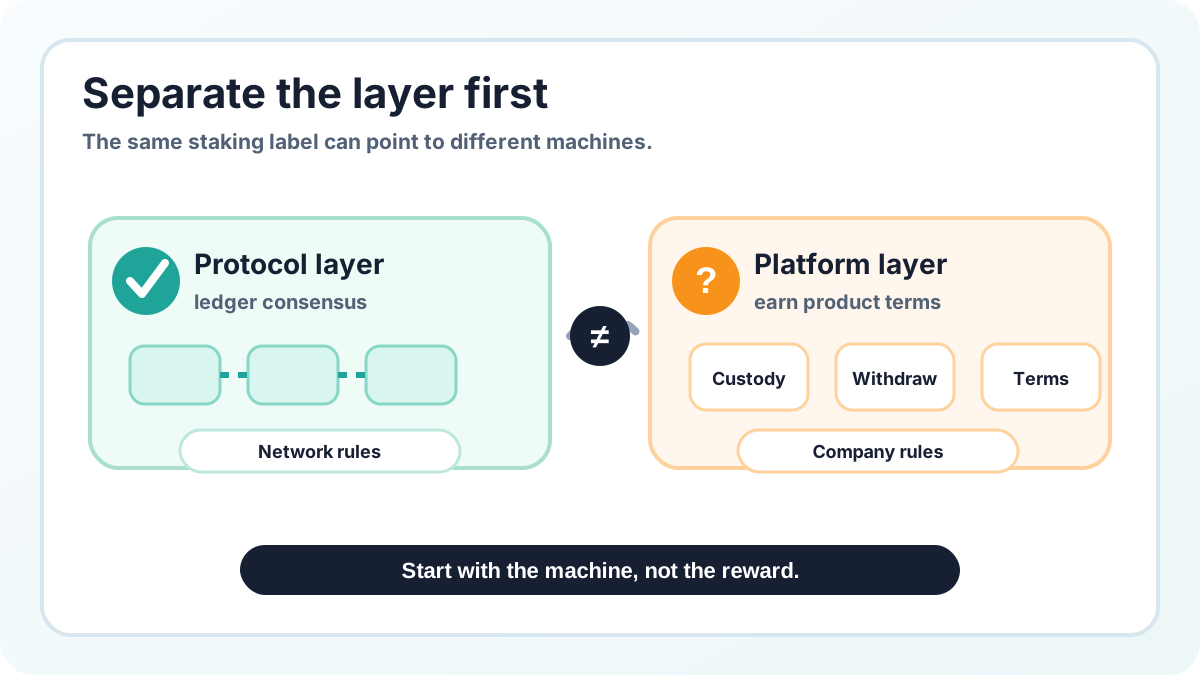
Separate the protocol layer from the platform product layer.
The important habit is boring but useful:
Do not ask only, "Can you stake XRP?"
Ask, "What exact product is being called staking, and who controls the rules?"
That second question is less exciting.
It is also the question that can save a beginner from walking into the wrong room.
What an XRP rewards product may involve
An XRP rewards product can look simple from the outside. Deposit XRP. Wait. Receive a reward.
The inside may be less simple.
The platform may require custody of the XRP. It may set a lock period. It may change reward rates. It may restrict withdrawals. It may use the assets in lending or liquidity operations. It may have eligibility limits based on location, account type, asset amount, or identity checks. It may reserve the right to stop or change the product.
Investor.gov's crypto asset interest-bearing account education is useful background here because many beginner mistakes come from treating an interest-bearing crypto product like a normal bank deposit or a native network reward. Those are different categories with different protections, obligations, and risks.
This is where the mental model becomes simple:
Protocol staking asks, "How does the network work?"
Platform earn asks, "What is this company doing with my asset, and what happens if something goes wrong?"
The second question is not answered by the word XRP. It is answered by the product terms.
That means the most important document is often not the marketing page. It is the terms page, fee schedule, risk disclosure, lockup rule, withdrawal rule, and reward calculation.
Marketing tells you what the product wants you to notice.
Terms tell you what the product is allowed to do.
Risks beginners should check before chasing yield
Yield has a strange effect on the beginner brain. A normal asset becomes a bored asset. Then a reward offer appears, and suddenly the asset seems unemployed unless it is earning something.
This is how a simple holding decision turns into a product-risk decision. Other products, including crypto leverage trading, carry the same lesson: the product design can change the size and speed of the risk.
Before chasing XRP rewards, a beginner should check at least five risk layers.
The first is custody risk. Who controls the XRP while the product is active? If the platform holds it, the user is depending on the platform's security, solvency, access rules, and operational behavior.
The second is withdrawal risk. Can the XRP be withdrawn at any time, or is there a lock period, queue, delay, review, minimum, or emergency pause?
The third is counterparty risk. If the reward comes from lending, market making, liquidity provision, or another platform activity, the beginner is not just exposed to XRP. They are exposed to the platform and its counterparties.
The fourth is rule-change risk. Reward rates, eligibility, supported regions, minimum amounts, and product access can change. A product that looks attractive today may have different terms later.
The fifth is misunderstanding risk. This one sounds softer, which is why it is dangerous. A beginner may believe they are participating in native staking when they are actually joining a custodial earn product. The user is then making a decision about one thing while thinking about another thing.
That is the classic beginner problem.
The person thinks they are choosing a coin feature.
They are actually accepting a platform agreement.
A simple checklist before using any XRP staking offer
Before using any offer described as XRP staking, XRP earn, or XRP rewards, the beginner should be able to answer these questions without borrowing language from the platform's headline:
Is this native protocol staking, or a platform product?
Who controls the XRP while the product is active?
Can the XRP be withdrawn immediately, or is there a lockup, delay, queue, or minimum?
How are rewards generated?
Are the rewards fixed, variable, promotional, or discretionary?
Can the platform change the rate, terms, eligibility, or access rules?
What fees, spreads, minimums, or account requirements apply?
What happens if the platform pauses withdrawals or ends the product?
Which official product document explains the rules?
Would the offer still make sense if the reward rate were lower?
The last question is useful because it removes the shiny part.
If the product only makes sense because a reward number is floating in front of it, the beginner may be buying a feeling instead of understanding a structure.
A good rule is: if the label says staking but the terms describe custody, lending, lockups, or platform discretion, treat it as a platform financial product first and a staking product second.
Maybe it is still something a user wants to study.
But it should not be treated as a passive network feature.
How this fits inside crypto financial products
XRP staking is a good example of why crypto financial products need slow reading.
The asset is one layer.
The protocol is another layer.
The platform product is another layer.
The marketing label is yet another layer, usually wearing the brightest clothes.
Beginners often try to understand all four layers as one thing. That is where the confusion comes from. XRP is the asset. XRP Ledger is the network. "XRP earn" may be a product. "Staking" may be a label.
Those distinctions can feel fussy until money is involved.
Then they become the whole point.
This is also why a legal classification question, such as whether an asset is a security token, belongs in its own discussion. It is related to crypto financial products, but it is not the same as the staking question. A user can misunderstand an XRP rewards product even if they never touch the legal debate.
So the safer beginner posture is plain:
Do not start with the reward.
Start with the machine.
Find out whether the machine is the protocol or the platform. Find out who controls the asset. Find out what can change. Find out what happens when the user wants to leave.
Only then does the reward number become information instead of bait.
FAQ
Can you stake XRP?
Not in the usual native proof-of-stake reward sense on XRP Ledger. If a platform advertises XRP staking, it is often referring to an earn, rewards, lending, or promotional product controlled by that platform's terms.
Is XRP staking the same as XRP earn?
Usually, no. XRP earn is a platform product label. It may pay rewards, but the product rules, custody model, withdrawal terms, and reward source depend on the platform.
Are XRP rewards risk-free?
No. XRP rewards products can involve custody risk, withdrawal limits, counterparty risk, changing terms, and misunderstanding risk. The exact risks depend on the product.
Should beginners use XRP staking platforms?
Beginners should not choose a platform just because it uses the word staking or shows a reward rate. They should first understand whether the offer is a protocol feature or a platform financial product, then read the official terms.
Is this about whether XRP is a security?
No. Legal classification is a separate topic. The practical issue here is the difference between protocol staking and platform earn or rewards products.
Official References
Risk Disclaimer
This article is for beginner education only. It is not financial, investment, legal, tax, custody, or security advice. Bitcoin transactions can be irreversible, Bitcoin is volatile, and wallet mistakes can cause permanent loss. Wallet software, platform rules, withdrawal support, security features, and recovery processes can change. Check official wallet and platform documentation before acting, and use qualified professional help when needed.
Editorial Attribution
Written by Alex Chen. Reviewed by Jordan Blake for factual accuracy, clarity, and beginner safety.
Recommended Topics


Latest Articles

Stablecoin Prices: How Stablecoins Hold Their Value