
What Is Leverage Trading in Crypto?
Summary
Learn what leverage trading in crypto means, how margin, collateral, liquidation, fees, funding, and volatility affect risk, and why leverage is not a profit button.
Searching for leverage trading crypto usually starts with one tempting idea: a small account can control a bigger position.
That sounds like a larger account.
It is better understood as a more sensitive account.
Leverage does not make a trader more accurate. It does not make the market kinder. It does not turn a risky idea into a controlled idea. It changes how much the account reacts when the price moves. A small move can feel larger. A normal loss can arrive faster. A mistake that would have been annoying without leverage can become urgent with leverage.
That is the central mental model: leverage is not a profit button. It is a sensitivity dial.

Leverage is not a profit button. It is a sensitivity dial.
Leverage trading in one sentence
Leverage trading in crypto means using borrowed, margined, or platform-provided exposure so a position is larger than the collateral placed behind it.
That definition has two important parts.
The first part is larger exposure. The position behaves as if it is bigger than the starting collateral.
The second part is collateral. The platform or product usually needs something behind the position. That collateral is what absorbs losses, supports the position, and may disappear quickly if the trade moves the wrong way.
This is why crypto leverage can feel simple on a screen and become complicated in real life. The interface may show a position, a direction, and a result. Under the surface sit margin rules, liquidation rules, funding costs, fees, eligibility limits, and platform-specific mechanics.
The visible number is the small part.
The rules are the machine. This is why leverage belongs inside the broader world of crypto financial products, not inside a simple profit-button story.
How leverage magnifies exposure
Without leverage, a price move changes the value of the asset or position you actually hold.
With leverage, the account is connected to a larger exposure than the starting collateral would normally allow. That means the same price move can have a larger effect on the collateral.
This is the part beginners often understand only halfway.
They understand the exciting half: if the position moves in the right direction, gains can appear larger relative to the starting collateral.
They miss the other half: if the position moves in the wrong direction, losses can also appear larger relative to that collateral.
The market did not become more predictable. The account became easier to damage.
A useful way to picture it is a long handle attached to a small door. The handle makes the door easier to move, but it also makes every accidental shove matter more. Crypto leverage is that handle. It gives the price movement more force against the account.
That force can point both ways.
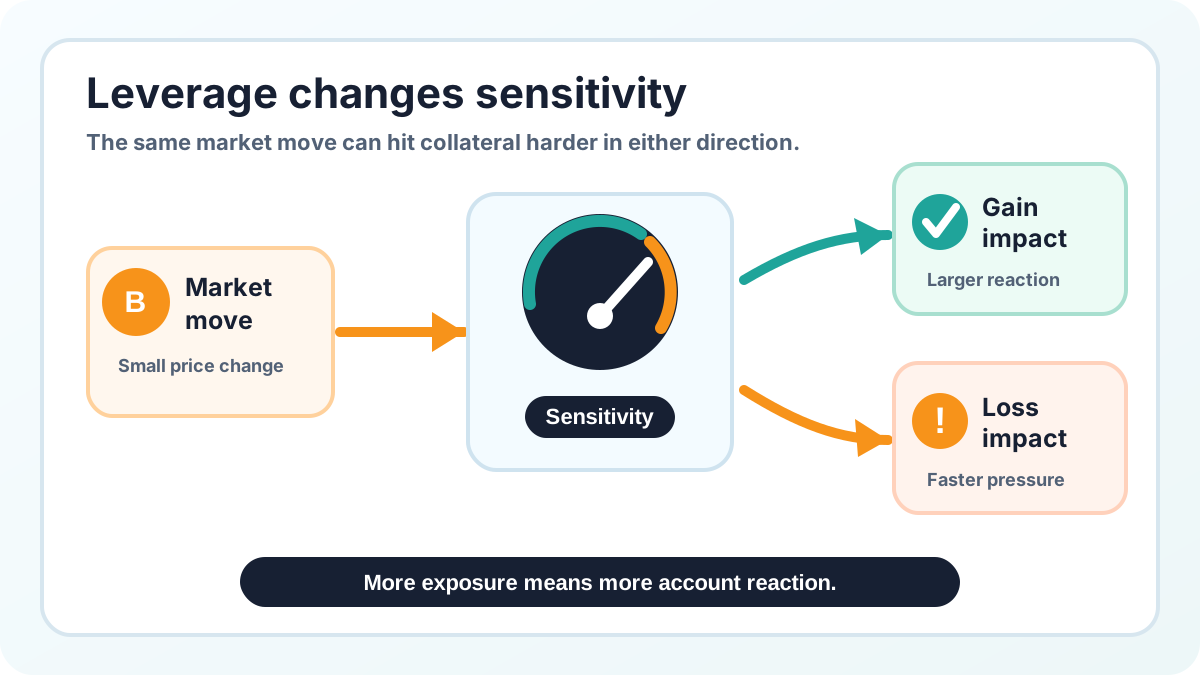
Leverage makes the account more sensitive in both directions.
Margin, collateral, and liquidation
Margin is the support behind the position. Collateral is what the account puts at risk to keep the position open. Liquidation is what can happen when the support is no longer enough under the product or platform rules.
Investor.gov's margin education describes margin accounts as borrowing arrangements with special risks, not ordinary cash accounts. Crypto platforms and products can have their own rules, but the beginner lesson is similar: margin is not free extra buying power. It is a risk structure.
Term | Beginner meaning | Why it matters |
|---|---|---|
Leverage | Larger exposure than your starting collateral | Gains and losses can affect the account faster |
Margin | Collateral set aside to support a position | Falling margin can trigger platform action |
Liquidation | A rule-based closeout by the platform or product | You may lose collateral quickly |
Funding / fees | Ongoing or transaction costs around the position | Costs can change the real result |
Volatility | Fast or large price movement | Crypto moves can hit risk limits quickly |
Liquidation deserves special attention because the word sounds cleaner than the experience.
It is not a calm educational notification. It is usually a rule-based process. If the account no longer meets the product's requirements, the position may be closed automatically. The user may not get to negotiate with the interface. The platform is following its rules, not reading the user's intentions.
That is why a beginner should never treat liquidation as a distant technical detail. In leveraged crypto trading, liquidation is one of the main ways the product protects itself from the user's losing position.
Which is not the same as protecting the user.
Why crypto volatility makes leverage especially risky
Crypto prices can move quickly. Bitcoin can move quickly. Smaller crypto assets can move even more aggressively.
That is already difficult without leverage.
With leverage, volatility becomes pressure. The same price movement has a larger account effect because the position is larger than the collateral behind it. A market that is merely uncomfortable without leverage can become unforgiving with leverage.
CFTC investor education warns that virtual currency trading involves serious risk, including volatility and platform-related risks. That matters here because leverage depends on both price movement and product mechanics. A beginner is not only asking whether the price will go up or down. They are also relying on the platform's margin rules, liquidation rules, available liquidity, fee model, and system behavior during fast markets.
This is why leverage can produce the worst kind of beginner lesson: a lesson that is technically clear only after the money is gone.
The price moved.
The collateral shrank.
The platform rule activated.
The account learned the definition of liquidation after it needed the definition.
Fees, funding, and platform rules beginners miss
Beginners often stare at the direction of the trade and forget the plumbing around the trade.
The plumbing matters.
A leveraged product may include trading fees, spreads, borrowing costs, funding payments, rollover costs, product fees, or other charges. Some costs are obvious at entry. Others appear over time. Some can change with market conditions or product rules.
Funding is especially easy to misunderstand. A beginner may think the only question is whether the price moves up or down. But if the position has ongoing funding or carrying costs, the clock also becomes part of the position.
Platform rules are another layer. A platform may change margin requirements, restrict products, alter supported collateral, pause certain features, or apply different liquidation logic across products. A clean-looking interface can hide a rulebook the user has not read.
That is the uncomfortable bargain of crypto leverage: the user wants a bigger position, and the product replies with a bigger rule stack.
The rule stack always matters more than the slogan.
Leverage vs shorting Bitcoin
Leverage and shorting are often mixed together, but they answer different questions.
Leverage is about size and sensitivity.
Shorting is about direction.
A leveraged long position is still betting on upward movement, but with amplified exposure. A leveraged short position is betting on downward movement, also with amplified exposure. The leverage changes how strongly the account reacts. The short changes which direction helps or hurts.
So a beginner should not treat "leverage trading" and "shorting Bitcoin" as the same topic. The separate question of how to short Bitcoin belongs in a different article because shorting has its own product categories and risks.
The clean distinction is:
Leverage asks, "How large is the exposure compared with my collateral?"
Shorting asks, "Which direction does the position benefit from?"
A product can combine both questions. That is exactly why the questions need to stay separate in the reader's head.
A simple example without trading instructions
Imagine a beginner opens a leveraged crypto position after watching the price move for a while.
At first, the position moves in the right direction. The account reacts quickly, and the beginner feels that leverage has made the market easier to use.
Then the price reverses.
The same sensitivity that made the gain feel exciting now makes the loss feel sudden. The collateral supporting the position shrinks. If the product's margin requirements are no longer met, the platform may close the position under its rules.
Nothing mystical happened.
The beginner used a sensitive instrument and then met a normal market move.
That is the problem. Leverage can make ordinary market movement feel like an emergency. It does not need a historic crash to create trouble. It only needs enough movement in the wrong direction to reach the product's rule boundary.
What to understand before using leveraged products
Before using any leveraged product, a beginner should be able to explain the product without repeating platform marketing language.
The useful questions are plain:
What product creates the leverage?
What collateral supports the position?
What can trigger liquidation or automatic closeout?
Can losses exceed the starting collateral?
What fees, funding, or borrowing costs apply?
Can the platform change margin requirements or product access?
What happens during fast markets or low liquidity?
Is the position long, short, or something more complex?
What official product or platform document explains the rules?
What would make the product unacceptable before any trade is opened?
The last question is the most important one.
If the only answer is "I hope the price moves my way," the product is already too complicated for the plan.
Crypto leverage is not automatically wrong. But it is rarely a beginner's best classroom. A good classroom lets mistakes stay small enough to learn from. Leverage is famous for doing the opposite.
FAQ
What is leverage trading in crypto?
Leverage trading in crypto means using borrowed, margined, or platform-provided exposure so a position is larger than the collateral placed behind it. It can magnify both gains and losses.
Is crypto leverage the same as margin trading crypto?
They are closely related, but wording varies by product and platform. Margin trading crypto usually involves collateral supporting a larger position. Other leveraged products may use different structures, contracts, or rules.
What is liquidation in crypto leverage trading?
Liquidation is a rule-based closeout that can happen when the account or position no longer meets the product's margin or collateral requirements. The exact rules depend on the platform or product.
Does leverage trading only mean shorting Bitcoin?
No. Leverage is about position size and account sensitivity. Shorting is about direction. A leveraged position can be long or short.
Is leverage trading safe for beginners?
For most beginners, leverage is a high-risk area to avoid until the mechanics are clear. Understanding price direction is not enough. The reader also needs to understand margin, liquidation, fees, funding, volatility, and platform rules.
Official References
Risk Disclaimer
This article is for beginner education only. It is not financial, investment, legal, tax, custody, or security advice. Bitcoin transactions can be irreversible, Bitcoin is volatile, and wallet mistakes can cause permanent loss. Wallet software, platform rules, withdrawal support, security features, and recovery processes can change. Check official wallet and platform documentation before acting, and use qualified professional help when needed.
Editorial Attribution
Written by Alex Chen. Reviewed by Jordan Blake for factual accuracy, clarity, and beginner safety.
Recommended Topics


Latest Articles

Stablecoin Prices: How Stablecoins Hold Their Value