
Stablecoin Prices: How Stablecoins Hold Their Value
Summary
Learn what stablecoin price means, how stablecoin pegs work, why depegs can happen, and what beginners should check before relying on a stablecoin.
Searching for stablecoin price can feel like asking why a ruler says one inch is one inch.
Many stablecoin prices appear boring on purpose. A token is often designed to hover near a target value, commonly one unit of a reference asset such as the U.S. dollar.
But boring is not the same as automatic.
A stablecoin price is not held in place by a magic sticker that says "$1." It is held, when it works, by a mechanism: the design of the token, the assets behind it, the rules for redemption, the issuer's credibility, market demand, and the networks where people move it around.
The price on a screen is the small visible part.
The machinery is the part beginners need to understand.

A stablecoin price is the visible surface of a larger mechanism.
Stablecoin price in one sentence
Stablecoin price means the market value of a stablecoin, usually measured against the asset it is trying to track.
For many dollar-linked stablecoins, the target is near $1. That is why stablecoin prices can look flat compared with Bitcoin or other crypto assets. The point is not to be exciting. The point is to behave like a crypto token that tries to track something outside itself.
That is different from what backs Bitcoin, where there is no issuer trying to keep one coin near one dollar.
The Federal Reserve's stablecoin education describes the basic idea behind the name: stablecoins are designed to maintain a stable value relative to a reference asset. That design goal is important. It explains why the word "stable" appears in the first place.
It does not prove that every stablecoin will always stay stable.
That is the beginner trap. A target price and a guaranteed price are not the same thing. A sign pointing toward a bridge is not the bridge. The stablecoin peg is the intended relationship. The actual price is what the market is willing to pay at a given moment.
So a stablecoin price near $1 is a signal that the mechanism is currently being trusted by the market.
It is not a law of physics.
Why many stablecoins try to track another asset
Crypto has plenty of assets that move like a startled dashboard needle. Stablecoins exist because users often want something less jumpy inside crypto systems.
A stablecoin can be used as a trading pair, a transfer asset, a payment rail, a temporary parking place, or a unit of account inside an app. In those settings, a token that swings wildly every few minutes is annoying. The user does not want the "dollars" in the app to develop a dramatic personality before lunch.
That is why many stablecoins aim to track a reference asset. The reference asset gives the token a target. The target gives users a simple mental shortcut: one token is supposed to be worth about one unit of the thing it tracks.
But the shortcut can become dangerous if it replaces the mechanism.
A stablecoin does not stay near its target because users prefer tidy numbers. It needs a reason for market participants to believe the token can be created, redeemed, traded, or arbitraged back toward the target. Different stablecoins use different designs, and those designs have different risks.
This is the first mental split:
The target is the promise.
The mechanism is the machine trying to keep the promise from wandering off.
The machine matters more than the sticker.
Pegs, reserves, redemptions, and issuer trust
A stablecoin peg is the target value the token tries to track.
The peg is only one piece. The full risk picture usually includes reserves, redemption, issuer trust, and the network where the token moves.
The U.S. Treasury's stablecoin report discusses stablecoin arrangements in terms of reserves, redemption, market confidence, and payment-system risks. That matters because a beginner may look only at the price and miss the stack of assumptions under the price.
The stack looks like this:
Factor | Beginner meaning | Why it affects stablecoin risk |
|---|---|---|
Peg | Target value the stablecoin tries to track | Price can move if confidence or mechanics fail |
Reserves | Assets claimed to support the token | Reserve quality and transparency matter |
Redemption | Ability to exchange tokens under rules | Not all users may have direct redemption access |
Issuer | Organization behind the stablecoin | Terms, jurisdiction, operations, and trust matter |
Network | Blockchain used to transfer it | Wrong network, fees, and support limits can create user mistakes |
Use the table as a map of the hidden room behind the price.
Two stablecoins can both appear near $1 and still have different designs, different reserve disclosures, different redemption rules, different issuers, and different network support. From far away, they look like identical price tags. Up close, they are different machines.
That is why the phrase "stablecoin price" can be misleading. The price is the headline. The mechanism is the story.
Why stablecoins can still move away from the target
A stablecoin depeg happens when the stablecoin trades away from its intended target value.
Sometimes the movement is small and temporary. Sometimes it is larger and more serious. The word depeg can cover a range of situations, so beginners should avoid treating it as one fixed event.
A stablecoin can move away from the target for several reasons.
Market confidence can weaken. If users doubt the reserves, issuer, redemption process, or product design, they may sell the token at a discount.
Liquidity can become thin. A token may trade near the target in normal conditions, then move more sharply when many people try to exit at once.
Redemption access can matter. If only certain institutions or users can redeem directly with the issuer, ordinary holders may depend on secondary markets, exchanges, or other routes.
Operational issues can matter. A platform may pause withdrawals, a network may become expensive, or support may differ across chains.
Design can matter. Some stablecoins are backed by traditional assets. Some use crypto collateral. Some use more complex mechanisms. The design decides where the weak points live.
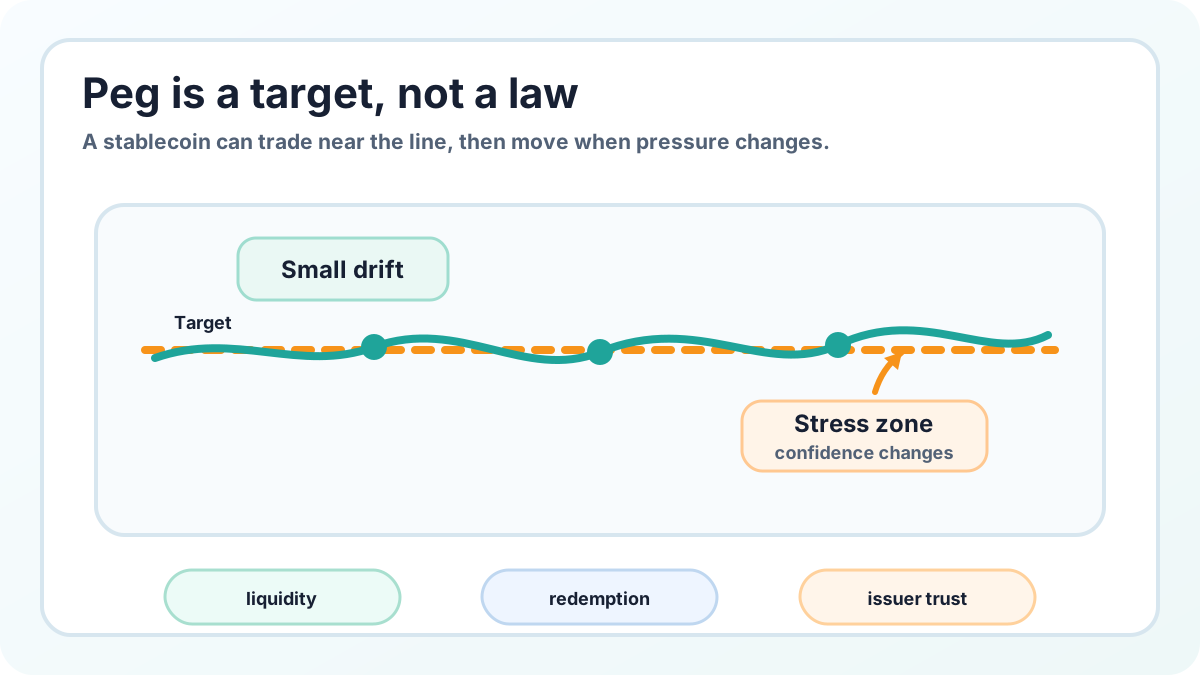
A peg is a target relationship, not a law of physics.
None of this means every stablecoin is fragile in the same way.
It means the stable part is an outcome that depends on conditions. A bridge can look perfectly calm when nobody is running across it. The more useful question is what the bridge is made of, who maintains it, and what happens when everyone tries to cross at once.
Stablecoins are not the same as cash in a bank
Beginners often use stablecoins because they feel familiar.
The interface shows a number near $1. The token name may include "USD." The price chart looks calmer than most crypto charts. The brain relaxes and quietly files the thing under "basically dollars."
That little filing decision can cause a lot of confusion.
A stablecoin is a crypto token with a design that aims to track a reference asset. Cash in a bank account is a different legal, operational, and protection structure. The two may feel similar inside an app, but similar feeling is not the same as identical rights.
The difference can show up in several places:
Who can redeem directly with the issuer
What assets support the token
Whether reserves are transparent and high quality
Which platform or wallet controls access
Whether transfers happen on the correct network
Whether a user has support if something goes wrong
What laws, terms, and protections apply
This is why "stablecoin" should not be translated in the beginner brain as "risk-free cash." It is better translated as "a crypto product trying to hold a target value."
That is less cozy.
It is also more accurate.
What beginners should check before using a stablecoin
Before using a stablecoin, a beginner should slow down long enough to answer a few plain questions.
What asset is the stablecoin trying to track?
What mechanism is supposed to keep the price near the target?
Who is the issuer or main organization behind it?
What do official documents say about reserves?
Who can redeem directly, and under what rules?
Which network is the token on?
Does the platform support deposits and withdrawals on that exact network?
What fees, minimums, or withdrawal rules apply?
What happens if the stablecoin trades below or above the target?
Is a live price page needed because the user is about to act, or is an explainer enough?
The last question matters because this page is not a live price page.
If a user is about to trade, send, withdraw, or rely on a current stablecoin price, they need current data from a reliable market source or official platform screen. An explainer can teach the map. It cannot update the weather.
That distinction is healthy. A beginner should use an explainer to understand how stablecoins work, then use current official or market data before taking any action.
One teaches the machine.
The other checks the dashboard.
How stablecoins fit inside crypto financial products
Stablecoins sit in a strange part of crypto financial products.
They often look less dramatic than volatile assets. They may feel like the quiet utility drawer in a noisy kitchen. But quiet tools can still have sharp edges.
Stablecoins connect several worlds: crypto networks, issuers, reserves, redemption rules, exchanges, wallets, payments, and regulation. That is why they can be useful and confusing at the same time.
They are not the same as wrapped assets. A wrapped asset usually represents another crypto asset on a different network. They are not the same as tokenized gold or commodity products. Those track a different kind of underlying exposure. They are not the same as a yield product, either. A stablecoin can be used inside a yield product, but the price mechanism and the yield product are separate questions.
This separation is important because beginners often stack risks without noticing.
They choose a stablecoin.
Then they choose a network.
Then they choose a platform, often before reading the platform rules.
Then they choose whether to hold, send, trade, or use it in another product.
Each layer adds rules. Each rule can matter.
The stablecoin price is only the first layer. It tells you where the token is trading. It does not tell you everything about reserves, redemption, issuer trust, network support, fees, or what happens when conditions change.
The better beginner habit is to treat stablecoin price as a starting question, not the whole answer.
FAQ
What does stablecoin price mean?
Stablecoin price is the market value of a stablecoin, usually compared with the asset it is trying to track. For many dollar-linked stablecoins, the target is near $1.
Why do many stablecoin prices stay near $1?
Many dollar-linked stablecoins are designed to track the U.S. dollar or another reference asset. The price may stay near the target when the market trusts the mechanism, reserves, issuer, and redemption process.
What is a stablecoin peg?
A stablecoin peg is the target value the stablecoin tries to follow. The peg is the intended relationship, not a guarantee that every holder can always sell or redeem at that exact value.
What is a stablecoin depeg?
A stablecoin depeg happens when the stablecoin trades away from its target value. It can happen because of confidence problems, liquidity stress, redemption limits, operational issues, or design weaknesses.
Are stablecoins risk-free?
No. Stablecoins can have reserve risk, issuer risk, redemption risk, platform risk, network risk, and market-confidence risk. They should not be treated as automatically risk-free cash.
Do I need a live stablecoin price page?
If you are about to trade, send, withdraw, or rely on the current price, use a reliable live data source or official platform screen. An explainer can show how stablecoin prices work, but it cannot replace live data.
Official References
Risk Disclaimer
This article is for beginner education only. It is not financial, investment, legal, tax, custody, or security advice. Bitcoin transactions can be irreversible, Bitcoin is volatile, and wallet mistakes can cause permanent loss. Wallet software, platform rules, withdrawal support, security features, and recovery processes can change. Check official wallet and platform documentation before acting, and use qualified professional help when needed.
Editorial Attribution
Written by Alex Chen. Reviewed by Jordan Blake for factual accuracy, clarity, and beginner safety.
Recommended Topics


Latest Articles

XRP Staking: Can You Stake XRP?