
Crypto Financial Products for Beginners
Summary
Learn how crypto financial products work, including ETFs, security tokens, staking, stablecoins, wrapped assets, and high-risk trading products.
Crypto financial products are not one thing. They are a whole shelf of wrappers, claims, tokens, contracts, and platform promises that can all sit near crypto without giving you the same thing.
That is where beginners get into trouble.
Even a basic how to buy Bitcoin flow is already a big enough idea. Then the industry adds ETFs, stablecoins, staking, earn products, wrapped Bitcoin, security tokens, short positions, leverage, tokenized gold, and product names that sound like they were assembled during a very long airport delay.
The tempting shortcut is to say, "It is all crypto."
That shortcut is too blunt. A coin in a wallet, a share of a fund, a token that tracks another asset, and a leveraged contract are different machines. They may all move when crypto markets move, but they do not give you the same rights, risks, or escape routes.
The useful beginner question is not "Is this crypto?"
The useful question is: "What exactly am I holding?"

Start with the product type, then ask what you actually hold.
Crypto financial products in one sentence
Crypto financial products are products that give you some kind of exposure to a crypto asset, crypto market, tokenized asset, or crypto-linked strategy.
Exposure is the key word.
Sometimes exposure means you own the actual coin or token. Sometimes it means you own a share, a claim, a balance inside a platform, a wrapped token, or a contract whose value depends on a price moving one way or another.
Those differences matter because each product has its own risk shape. A Bitcoin ETF is not the same as Bitcoin in your own wallet. A stablecoin is not automatically the same as cash. A wrapped token is not the same as the native asset it represents. A leveraged position is not just a larger version of a normal trade.
The wrapper changes the risk.
A beginner map of crypto product types
A simple map is better than a pile of product names.
Product type | Beginner meaning | You may actually hold | Main risk to understand |
|---|---|---|---|
Spot crypto | Buying the coin or token itself | Wallet asset or platform balance | Price volatility, custody, transfer mistakes |
Bitcoin ETF / fund exposure | Public-market product tied to Bitcoin exposure | Fund/share exposure, not withdrawable BTC | Fees, market price, issuer/custody structure |
Security token | Token that may represent regulated financial rights | Tokenized claim or rights | Legal status, issuer, compliance, liquidity |
Staking / earn product | Rewards or yield-like product | Network participation or platform product claim | Lockups, platform risk, changing terms |
Stablecoin | Token designed to track another asset | Token issued by a stablecoin issuer | Reserve, redemption, depeg, network risk |
Wrapped asset | Token representing another asset on another network | Wrapped/tokenized representation | Bridge, custody, smart-contract, and network risk |
Shorting / leverage | Product that magnifies or bets against price moves | Contract or margin position | Liquidation, fast losses, complexity |
This table is not a shopping list. It is a warning label for your brain.
When a product sounds familiar, your brain tries to borrow confidence from something it already understands. "ETF" sounds like traditional investing. "Stablecoin" sounds stable. "Earn" sounds friendly. "Wrapped Bitcoin" sounds like Bitcoin wearing a jacket.
The names are doing a lot of work.
Your job is to slow them down.
What you actually hold: coin, claim, token, or contract
Most crypto financial products fit into four beginner buckets:
A coin or token you can transfer.
A share or claim connected to an issuer, fund, or platform.
A tokenized representation of something else.
A contract tied to price movement.
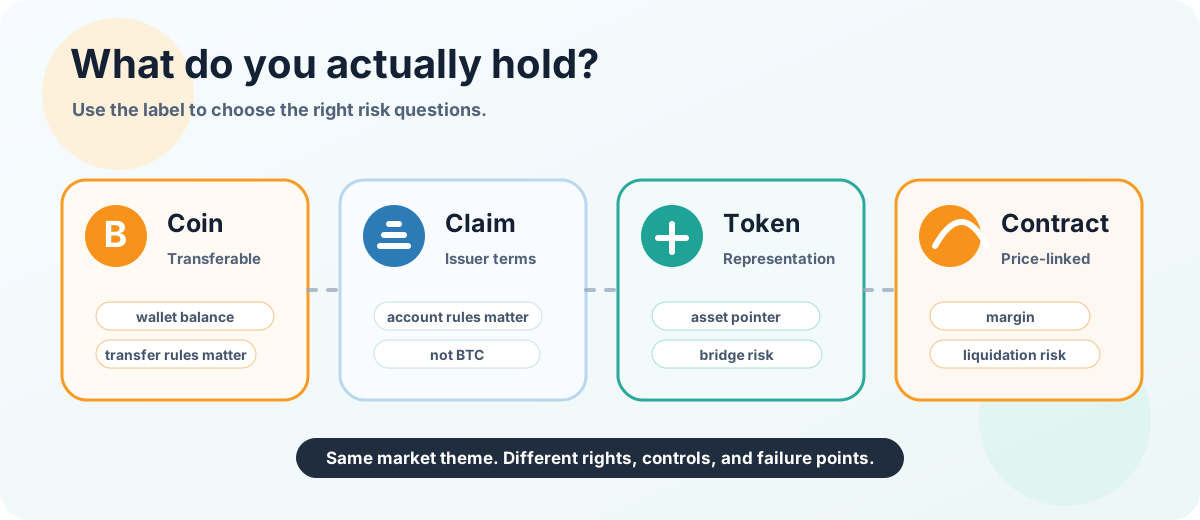
The label matters because the risks are different.
These are not just vocabulary differences. They answer different survival questions.
If you hold a coin or token, the important questions are about custody, wallet access, addresses, networks, and transaction mistakes. If you hold a fund share, the questions move toward fees, brokerage rules, fund documents, market price, and whether you can ever touch the underlying asset. If you hold a wrapped asset, the questions include bridges, custodians, smart contracts, and which network the token actually lives on. If you hold a leveraged contract, the questions become sharper: margin, liquidation, fees, funding, and whether a small price move can close the position before your brain has finished saying "wait."
One label can hide several layers of machinery.
So before you ask whether a product is good, ask what kind of product it is.
ETFs, funds, and public-market crypto exposure
A Bitcoin ETF or crypto-related fund can give public-market exposure to Bitcoin or another crypto theme. For many beginners, that sounds simpler than learning wallets, addresses, private keys, and on-chain transfers.
Sometimes it is simpler operationally.
But simpler does not mean identical.
If someone searches for fbtc stock, they may be trying to understand a spot Bitcoin ETF ticker, such as a Fidelity Bitcoin ETF product. The important beginner distinction is that ETF exposure is usually a fund/share exposure through a brokerage-style account. It is not the same as holding withdrawable Bitcoin in a wallet.
That means different questions. An ETF or fund account usually asks, "What price exposure do I have?" Direct crypto ownership asks, "What asset can I control, move, or withdraw?" One side points you toward fund documents, issuer pages, broker rules, fees, and market price. The other points you toward wallet control, platform custody, addresses, networks, and transfer mistakes.
That is the same split behind Bitcoin ETF basics: public-market exposure can track Bitcoin without becoming withdrawable BTC. How Bitcoin works covers the Bitcoin side of that distinction.
The key is not that one route is automatically better. The key is that they are different routes.
Different routes have different failure points.
Staking, earn products, and yield promises
Staking sounds beautifully simple: put crypto somewhere, receive rewards.
Reality is less tidy.
In some networks, staking is part of how the network works. In some platform products, "earn" or "staking" may mean the platform is offering rewards under its own terms. In some cases, assets may be lent, locked, pooled, delegated, or used inside a product structure that a beginner has not really read.
This is why a search like xrp staking needs care. The label can mean different things depending on the asset, network, platform, and product terms. An offer that looks like staking may be a platform earn product rather than native protocol staking.
That difference is not cosmetic.
It changes the risk questions. Is this native network staking, or a platform product using a familiar word? Who pays the reward, and under what terms? Is there a lockup? Who controls the asset while rewards are being earned? What risk produces the yield in the first place?
The word "yield" can make risk wear a nice shirt.
Do not stop at the number. Find the mechanism.
Stablecoins, wrapped assets, and tokenized assets
Some crypto products are built to represent something else.
A stablecoin may try to track a currency or other reference asset. Wrapped Bitcoin may represent Bitcoin on another network. Tether Gold may represent exposure to gold through a tokenized product. A security token may represent financial rights under a set of rules.
The basic idea is simple: a token can point to another thing.
The risk is that people start treating the pointer as if it were the thing itself.
A stablecoin price may sit near a target value most of the time, but that does not make every stablecoin risk-free cash. A wrapped Bitcoin token may track Bitcoin exposure, but it is not native BTC moving on the Bitcoin network. A gold-backed token may point to gold, but the user still has to understand issuer terms, custody, redemption rules, fees, and eligibility.
Network labels can also matter. A token labeled USDT ERC20 and a token labeled USDT BEP20 may sound like the same asset to a beginner, but wallets and platforms can treat different networks as different rails. Sending a token through the wrong network path can create a serious problem.
That is where the product map meets the transfer map.
Network and address rules are not side details here. They are the same failure points covered in wrong-network mistakes, fees and minimums, and wallet and storage basics.
Shorting, leverage, and products beginners should slow down on
Some products are not about holding a crypto asset at all. They are about a position.
Shorting Bitcoin means trying to benefit from downward price movement or getting short exposure through a product. Leverage trading crypto means using borrowed or amplified exposure so that a small price move can have a larger effect on the position.
This is where the room gets colder.
With spot crypto, the price can fall and hurt you. With leveraged products, the product can move against you fast enough to trigger liquidation or forced closure under platform rules. Fees, funding, margin requirements, and product mechanics can matter as much as the direction of the price.
For beginners, the most dangerous part is not just losing money.
It is misunderstanding the machine.
Do not treat those products as the next step after buying crypto. Treat them as complex financial tools that deserve a large pause.
What to check before using any crypto financial product
Before using any crypto financial product, ask boring questions.
Boring questions are underrated. They do not feel exciting, which is exactly why they are useful.
Product pages can also hide basic platform questions: access, identity steps, support routes, withdrawal rules, and account limits. The same platform choice questions still matter when the screen is selling something more complex than a simple spot buy.
Check | Question to ask | Why it matters |
|---|---|---|
Exposure | Am I holding the asset, a share, a claim, a platform balance, a wrapped token, or a contract? | The product may not equal direct ownership. |
Control | Who controls the asset, keys, collateral, or underlying exposure? | Control affects access and recovery. |
Issuer and rules | Who created or backs the product, and where are the official terms? | Rules and issuer risk can sit behind the interface. |
Costs and exit | What fees, lockups, or liquidity limits apply? | Costs and exit limits can change the real outcome. |
Leverage | Can losses move faster than I expect? | Leverage can turn small price moves into large account moves. |
Network | Which chain or transfer rail is being used? | Network mistakes can be hard or impossible to fix. |
If tax, legal, custody, or securities questions show up, do not improvise. Treat the risk disclaimer as the floor, then use qualified help.
None of these questions tells you what to buy.
That is the point. This page is not here to choose for you. It is here to stop product labels from doing your thinking for you.
FAQ
Are crypto financial products the same as owning Bitcoin?
No. Some products give direct coin or token ownership. Others give fund exposure, a platform claim, a wrapped token, a tokenized representation, or a contract. The difference changes custody, transfer, fees, and risk.
Is a Bitcoin ETF the same as Bitcoin?
No. A Bitcoin ETF can give exposure to Bitcoin's price, but it is not the same as holding withdrawable BTC in a wallet. Read the fund documents and account rules before assuming what you can do with it.
Is staking a guaranteed return?
No. Staking, earn, rewards, and yield products can involve network rules, platform terms, custody, lockups, changing rates, and counterparty risk. A reward label does not remove risk.
Are stablecoins risk-free?
No. Stablecoins can involve issuer risk, reserve risk, redemption rules, depeg risk, network risk, and platform restrictions. They may aim to track a value, but that does not make them risk-free cash.
What is the difference between a token, a claim, and a contract?
A token may be a transferable crypto asset or representation. A claim depends on an issuer, platform, or product terms. A contract is exposure based on a set of rules, often tied to price movement. The words matter because the failure points are different.
Is leverage trading suitable for beginners?
Leverage is usually a poor first learning step because it magnifies both gains and losses. Liquidation, margin rules, fees, and fast market moves can make losses happen faster than a beginner expects.
Should beginners choose the highest yield or lowest fee?
Not by itself. High yield may hide risk, and low fees may not tell you about custody, liquidity, platform terms, transfer networks, or product complexity.
Official References
Risk Disclaimer
This article is for beginner education only. It is not financial, investment, legal, tax, custody, or security advice. Bitcoin transactions can be irreversible, Bitcoin is volatile, and wallet mistakes can cause permanent loss. Wallet software, platform rules, withdrawal support, security features, and recovery processes can change. Check official wallet and platform documentation before acting, and use qualified professional help when needed.
Editorial Attribution
Written by Alex Chen. Reviewed by Jordan Blake for factual accuracy, clarity, and beginner safety.
Recommended Topics

Stablecoin Prices: How Stablecoins Hold Their Value
Crypto Financial Products
XRP Staking: Can You Stake XRP?
Crypto Financial Products
What Is Leverage Trading in Crypto?
Crypto Financial Products
How to Short Bitcoin: Methods, Risks, and Examples
Crypto Financial Products
FBTC Stock: Fidelity's Spot Bitcoin ETF Explained
Crypto Financial Products
Latest Articles
Stablecoin Prices: How Stablecoins Hold Their Value