
When people say they have lost Bitcoin, they may mean very different things. They may be locked out of an exchange account, missing a device, unable to find a wallet recovery phrase, or looking at a transaction sent to the wrong address.
Some of these situations may be recoverable through an official account or wallet process. Others may become permanently inaccessible when no valid signing key or backup remains. The first useful step is to identify what was lost before paying anyone who promises to recover it.

Recovery depends on which part of the access path is missing: an account, a device, a backup, or a signing secret.
The beginner model is simple: Bitcoin is recorded on the blockchain, while a wallet manages the keys used to authorize a transaction. Losing access usually means losing the ability to prove that you are allowed to spend the recorded funds.
What “Lost Bitcoin” Usually Means
There is no single recovery answer because there is no single kind of loss. Start by matching your situation to one of these four cases.
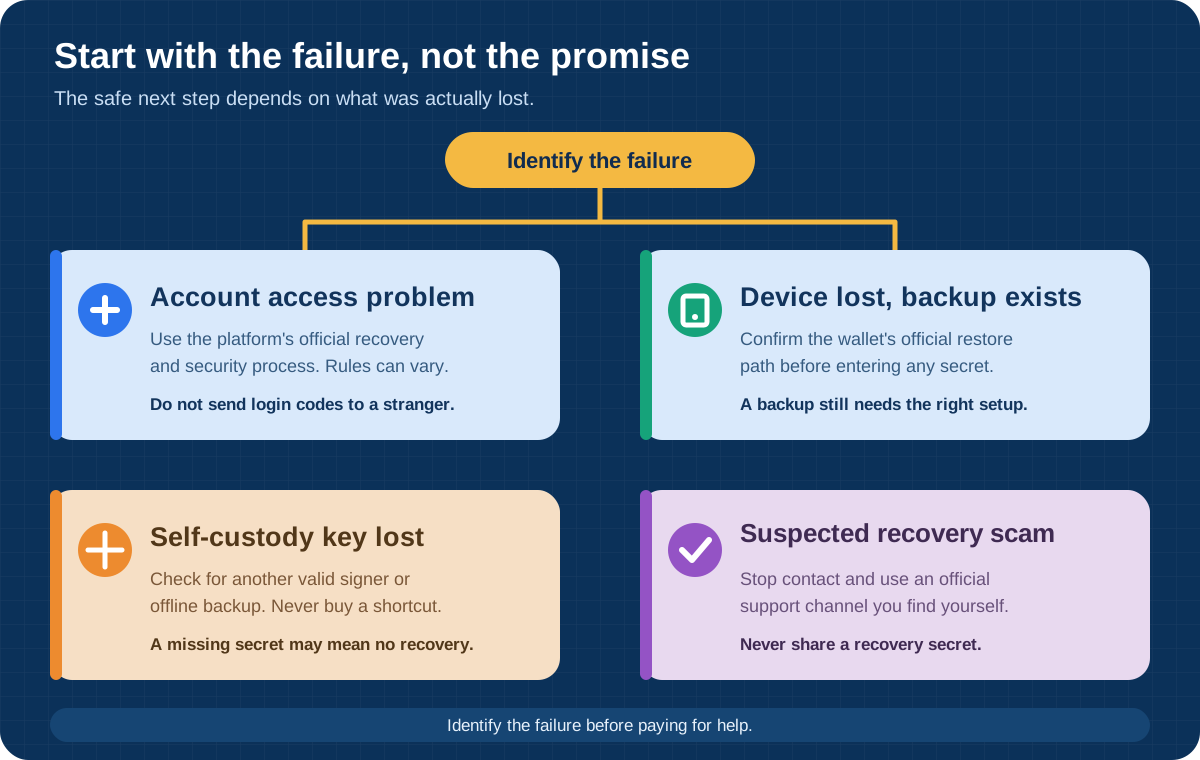
Identify the failure first. The next safe action is different for each branch.
You cannot sign in to a custodial account
If a company holds the keys on your behalf, the problem may be an account-access issue rather than a lost private key. You may need to use the provider's official sign-in recovery, identity-check, or support process. Those rules vary by provider, country, account history, and current policy.
Use the official website or app that you already know is genuine. Do not send a password, one-time code, private key, or recovery phrase to someone who contacts you through social media or direct message. Check the platform's current policy before acting, because account recovery and withdrawal rules can change.
Your phone, computer, or hardware wallet is gone
A lost device does not automatically mean lost Bitcoin. If you still have a valid backup and know which wallet or compatible recovery process created it, you may be able to restore access on a replacement device.
Restoration is not a guessing exercise. Confirm the wallet's official instructions, the correct app or device, and any important wallet settings before entering a recovery phrase. Some wallet designs use additional passphrases, account settings, or derivation choices. A phrase that opens an empty wallet may be valid but paired with the wrong recovery setup.
You lost the seed phrase or private key
Self-custody changes the responsibility. If you control the wallet keys, a company may not have a reset button for the secrets you lost. A lost private key or wallet recovery phrase can mean that the funds cannot be spent unless another valid backup or signing method exists.
Do not type random phrases into websites, send the phrase to a supposed recovery expert, or install unknown software that claims to scan for missing Bitcoin. These actions can expose the secret you still have.
The funds were sent to an address you did not intend to use
This is a transaction problem, not a forgotten-password problem. Bitcoin transactions may be irreversible after broadcast and confirmation. If you recognize the recipient, you can contact them through a trusted channel, but there is no general network command that reverses a confirmed payment.
If the transaction is unfamiliar, record the transaction ID and review the sending device, account, and security history through official channels. Do not assume that a stranger who identifies the transaction can return the funds.
Custodial Account vs. Self-Custody Wallet
The most important question is: who controls the private keys?
With a custodial account, a platform controls or manages the keys and gives you an account interface. If you lose access, the platform may have an official recovery process. That process is not guaranteed, and it may involve identity checks, security holds, regional limits, or other rules. Follow the provider's current policy rather than advice from an unofficial contact.
With a self-custody wallet, you control the signing secrets. The wallet app helps you view balances and create transactions, but it generally cannot recreate a seed phrase or private key that you never backed up. A phone number, email address, wallet address, or transaction ID does not replace the secret needed to sign.
Before looking for help, answer these questions:
Who authorized the wallet or account to spend?
Where was the original backup created and stored?
Is the problem a login, a device, a wallet configuration, or a missing secret?
Which official recovery instructions apply to the exact product or service?
The answer determines whether you should start with platform support, a documented wallet restore, a security review, or a decision to stop searching for a technical shortcut.
Seed Phrase, Private Key, Password, and Address Are Different
Beginners often use these words as if they were interchangeable. They are not.
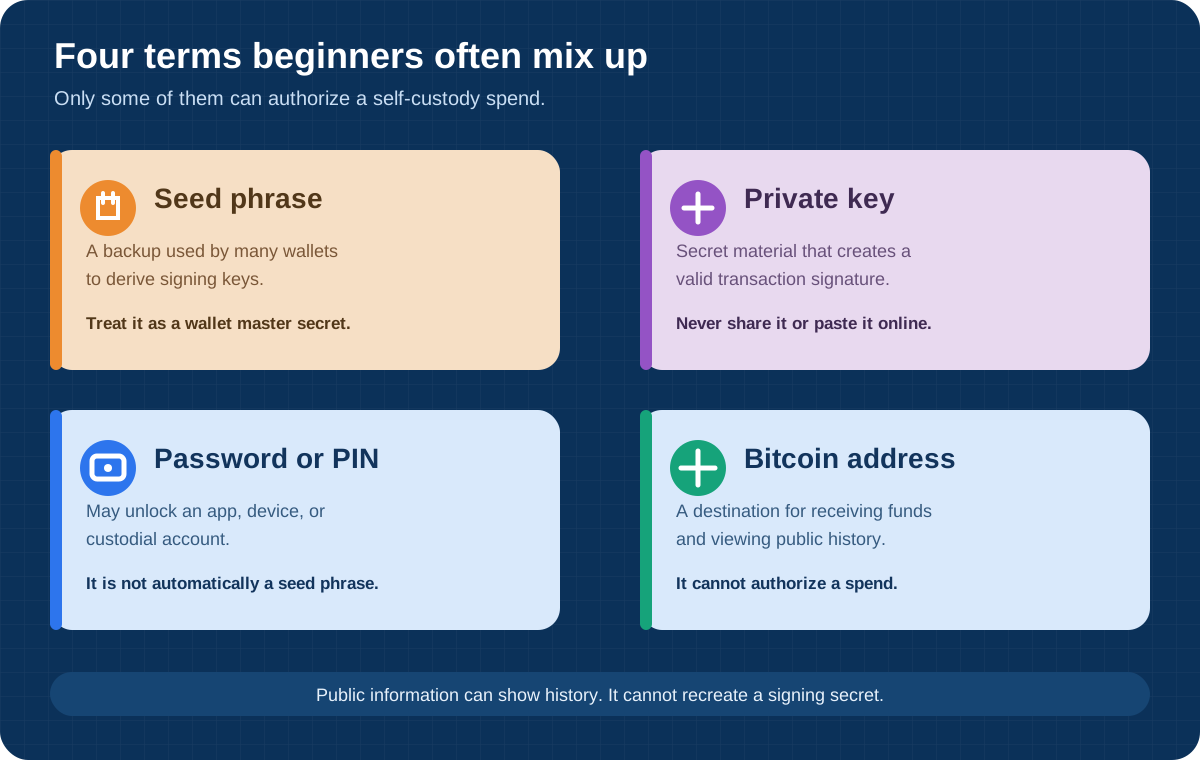
A password may unlock an app, but a signing secret is what authorizes a self-custody spend.
A seed phrase, also called a recovery phrase, is a backup representation used by many wallets to derive keys. Anyone who obtains it may be able to control the associated funds.
A private key is secret key material used to create a valid signature. It must never be shared.
A password or PIN may protect an app, device, or account. It is not automatically the same thing as a wallet recovery phrase.
A Bitcoin address is a destination for receiving funds. It can help you inspect public transaction history, but it does not give you the power to spend.
This is why searching for an address can help answer how to find lost bitcoins in the narrow sense of locating an on-chain balance or transaction history. It cannot recreate a missing private key. Public information can show what happened; it cannot prove control.
For a deeper comparison, see Private Key vs Seed Phrase vs Wallet Address.
What Recovery Can and Cannot Do
Recovery is possible only when the missing link can be replaced by a valid, authorized path.
Recovery may be possible when
You can complete an official custodial account recovery process.
You still have a valid seed phrase or other supported backup, and you use the correct wallet's official restore method.
You have another working signer or backup in a wallet design that supports it.
You sent funds to a person or service you can identify and they voluntarily return them through a new transaction.
None of these outcomes is automatic. Confirm the exact platform, wallet version, supported backup type, and current instructions before taking action.
Recovery may not be possible when
A self-custody private key or recovery phrase is missing and no other valid signer or backup exists.
Funds were sent to the wrong address and the recipient cannot or will not return them.
A secret was exposed and the funds were moved before you secured the wallet.
A wallet was restored with the wrong phrase, account, passphrase, or configuration and the original setup cannot be reconstructed.
When people ask what happens to lost bitcoins, the careful answer is that the blockchain can continue to record the funds and their history even when the owner can no longer produce a valid signature. The network does not know that a person is the rightful owner just because someone makes that claim.
Do not keep trying random recovery tools once you are unsure what you are doing. Each extra download, browser extension, or copied secret creates another chance for theft.
Watch for Bitcoin Recovery Scams
Loss creates urgency, and urgency is exactly what scammers use. A recovery service may appear polished, use technical language, or show a small fee before asking for a larger payment. None of that proves it can recover anything.
Common warning signs include:
A promise to recover 100% of the funds or a guaranteed result.
An unsolicited message claiming to be wallet support, a developer, a regulator, or a recovery expert.
A demand for an upfront deposit, tax, unlock fee, or second payment before a withdrawal.
A request for your seed phrase, private key, password, one-time code, or remote access to your device.
A website that asks you to connect a wallet or paste a secret before it will “scan” for Bitcoin.
Pressure to act immediately or keep the conversation secret.
Use the provider's official support page, not a search-ad contact, social-media account, or phone number sent by a stranger. If someone asks for a recovery phrase, stop. A real support conversation should not require you to disclose the secret that controls your wallet.

Pause before sending money or secrets to anyone who claims they can recover lost Bitcoin.
Prevention Checklist for Beginners
The easiest recovery problem to solve is the one you prepare for before you need it.
Write down the recovery phrase carefully. Check every word and its order. Do not photograph it, email it, or store it in a cloud note unless the wallet's official guidance specifically explains a secure method.
Keep an offline backup in a controlled location. Protect it from fire, water, theft, and casual access. Avoid keeping the only copy beside the device it is meant to restore.
Do not share private keys or recovery phrases. No legitimate-looking support badge changes this rule.
Record the wallet context without recording the secret publicly. Note the wallet name, supported network, account type, and any settings needed for restoration. Store this information separately from the recovery words when practical.
Rehearse recovery with a small, non-critical amount. A restore drill can show whether your backup, device, and instructions actually work. Read Bitcoin Wallet Restore Drill before testing.
Secure accounts separately. Use the platform's official security settings, keep contact details current, and review login or withdrawal alerts where available. Current features and limits can change.
Keep records for tax and security review. Cash-out, sale, and loss reporting may depend on your country and facts. Check current local tax guidance and platform policy before filing or acting.
The goal is not to create a perfect vault on paper. It is to make the next ordinary failure understandable: a lost phone, a forgotten login, a damaged backup, or a suspicious message should not force you into a rushed decision.
FAQ
Can lost Bitcoin be recovered?
Sometimes. A custodial account may have an official recovery process, and a self-custody wallet may be restorable if you still have the correct valid backup. If the only private key or recovery phrase is gone, or funds were sent to the wrong address, recovery may not be possible. Check the relevant official policy before paying anyone for help.
Can a wallet company reset my seed phrase?
Usually, a self-custody wallet cannot reset or recreate a seed phrase that it never held. A custodial provider may have an account-recovery process, but that is different from resetting a self-custody secret. Follow the exact wallet or platform's current official documentation and never send your seed phrase to support.
Are Bitcoin recovery services safe?
Do not assume that a service is safe because it uses professional language, testimonials, or a technical-looking website. Guaranteed results, upfront fees, unsolicited outreach, requests for wallet secrets, and remote-access demands are serious warning signs. Treat recovery offers as unverified until you can independently confirm the provider and its lawful, documented process.
What should I do before paying anyone?
Pause. Secure any account or wallet that may still be accessible, preserve transaction IDs and messages, and contact the platform or wallet maker through an official channel you locate yourself. Do not provide a seed phrase, private key, password, one-time code, or remote access. Check local reporting and tax obligations if money was lost or stolen.
Risk Disclaimer
This article is for general education, not investment, legal, tax, cybersecurity, or recovery-service advice. Bitcoin transactions may be irreversible, and losing a private key or wallet recovery phrase can lead to permanent loss of access. Never share a seed phrase, private key, password, or one-time code. Platform interfaces, identity checks, fees, limits, withdrawal rules, and regional availability can change, so check the platform's current policy before acting. For tax or loss-reporting questions, verify the current requirements with the relevant tax authority or a qualified professional in your jurisdiction.
Editorial Attribution
Written by Alex Chen. Reviewed by Jordan Blake for factual accuracy, clarity, and beginner safety.