
A Bitcoin TXID is the public transaction identifier assigned to an on-chain Bitcoin transaction. It is usually displayed as a 64-character string made from numbers and the letters a through f. You can paste that string into a Bitcoin block explorer to look up the transaction's public status, outputs, fee data, and confirmations.
Think of a TXID as a transaction's public fingerprint. It helps you point to one specific on-chain record. It is not a Bitcoin address, a password, a private key, or proof by itself that the intended person received spendable funds.

A TXID identifies a public transaction record; the receiving address and the transaction's status are separate facts to check.
The word looks technical because it is technical. The useful part is much simpler: if a wallet says a Bitcoin transaction was broadcast, the TXID is the reference you use to find that transaction on the public network.
What a Bitcoin Transaction ID Means
TXID stands for transaction ID or transaction identifier. Bitcoin software derives it from the transaction data, which means changing the transaction would produce a different identifier. Wallets, nodes, and block explorers use the TXID to refer to the same transaction.
This gives beginners a practical three-part model:
The Bitcoin address says where an output can be spent under the required conditions.
The TXID points to the transaction record that created or spent outputs.
The confirmation count tells you whether that transaction has been included in a block and how many blocks have been added after it.
Those three pieces often appear together on a receipt or explorer page, which is why they are easy to mix up. They do different jobs.
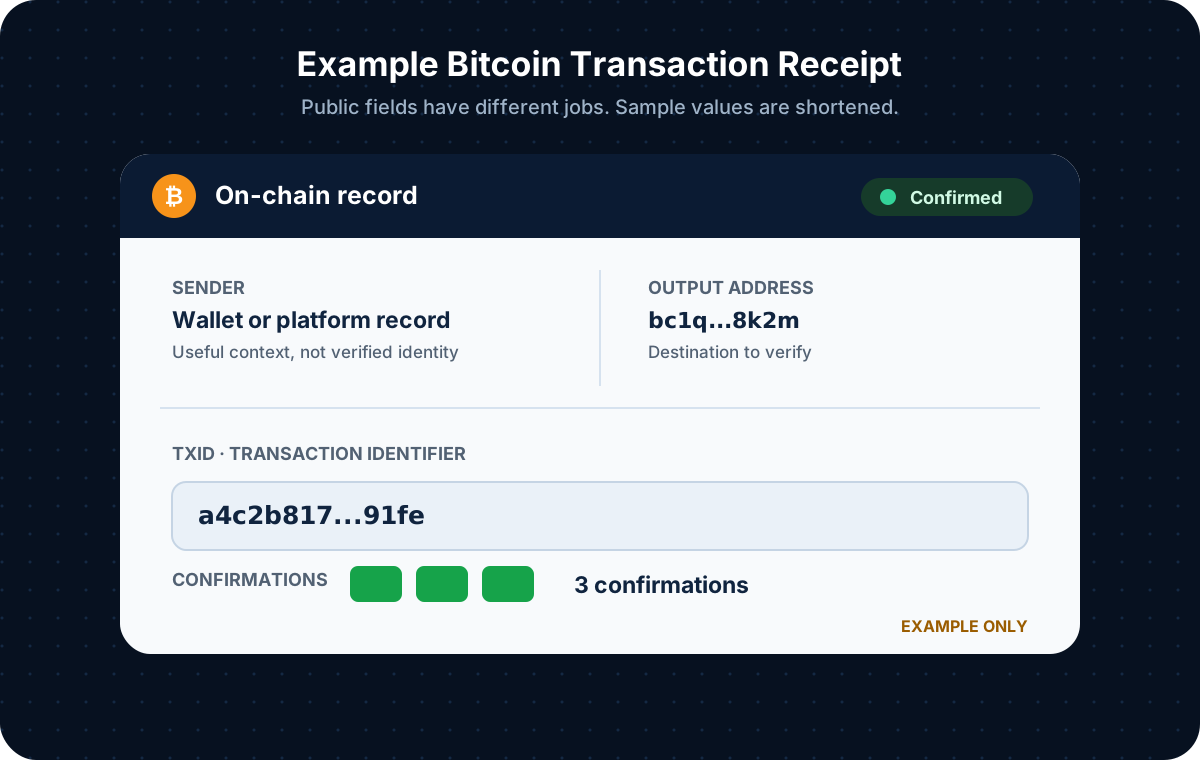
A receipt may show several identifiers. The TXID points to the transaction; it does not replace the address or status.
The sample values in this diagram are deliberately shortened. A real BTC TXID is normally shown as a full 64-character hexadecimal string.
Where Beginners May Find a TXID
After sending Bitcoin, open the transaction details in the wallet or platform you used. Look for a label such as:
Transaction ID
TXID
Transaction hash
View on block explorer
The wording and location vary. A self-custody wallet may show the TXID soon after it broadcasts the transaction. A custodial platform may first show a withdrawal as processing because it has not yet created or broadcast an on-chain transaction. Its interface, approval steps, fees, limits, and timing can change, so use the platform's current official help page when the field is unclear.
If you received Bitcoin, your wallet may show the incoming transaction and its TXID in the activity history. You can also search a known receiving address in a block explorer and then select the relevant transaction, but address searches reveal more public activity than a single TXID search. Consider the privacy tradeoff before sharing an explorer link.
Do not paste a seed phrase, private key, wallet backup, password, or one-time code into a block explorer. A legitimate public lookup needs only public data such as a TXID, block hash, or Bitcoin address.
TXID vs. Bitcoin Address
A Bitcoin address is used as a destination when receiving Bitcoin. A TXID identifies a transaction that may have one or more inputs and one or more outputs.
A single transaction can create outputs for multiple addresses. It can also include a change output that returns remaining value to a wallet controlled by the sender. That is why seeing your address somewhere on an explorer page is more useful than seeing a familiar-looking sender label, but it still requires context.
Here is the simplest distinction:
Item | What it identifies | What it does not prove |
|---|---|---|
Bitcoin address | A destination or spending condition for an output | The real-world identity of its controller |
TXID | One specific on-chain transaction record | That the intended recipient controls an output |
Confirmation count | The transaction's current inclusion depth | That a platform has credited or released funds |
For a deeper explanation of address formats and copy-paste safety, read Bitcoin Wallet Address Explained.
How to Check a TXID in a Block Explorer
You do not need to understand raw transaction code to perform a basic check.
Copy the TXID from the wallet or platform you actually used. Use the transaction details screen or the provider's official withdrawal record. Do not copy an identifier from an unsolicited message.
Open a reputable Bitcoin block explorer. Check the domain carefully. A block explorer is a public lookup tool, not a wallet recovery service.
Paste only the TXID into the search field. Never enter a private key or recovery phrase.
Match the transaction details. Compare the amount, relevant output address, time, status, and confirmations with your own record. Remember that explorers may display times, fees, and values differently.
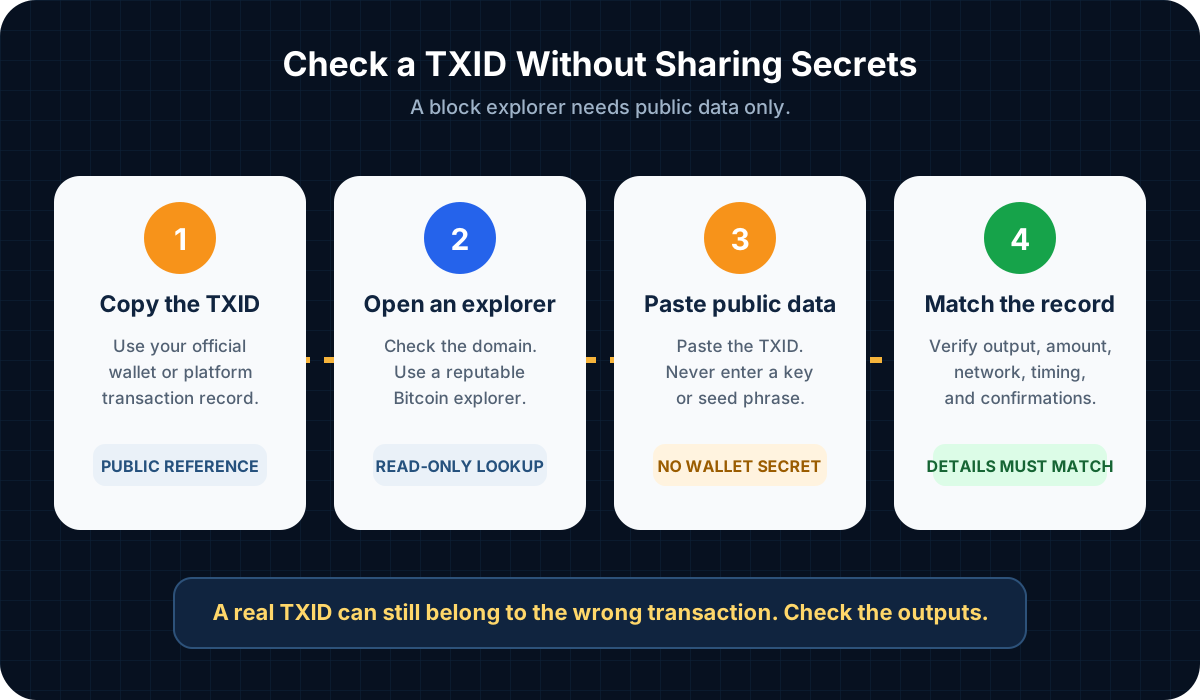
Use the TXID as a lookup key, then verify the outputs and status instead of trusting the string alone.
Our Blockchain Explorer guide explains the common fields in more detail. If you are still preparing a payment, use the complete How to Send Bitcoin checklist before broadcasting it.
Pending, Unconfirmed, and Confirmed Transactions
A TXID can exist before a transaction is confirmed. That is the part that surprises people.
When a valid transaction is broadcast, Bitcoin nodes may accept it into their mempools while miners consider it for a block. During this stage, an explorer may label the transaction as unconfirmed, pending, or 0 confirmations. It may still be delayed, dropped from some mempools, conflict with another transaction, or be replaced when the transaction was created with a supported fee-replacement policy.
After a miner includes it in a block accepted by the network, the transaction has one confirmation. Each later block increases that count. Wallets, merchants, and platforms choose their own policies for when they treat a payment or deposit as sufficiently settled. A visible TXID therefore does not mean every service will immediately credit the funds.
If you are waiting, check the explorer status and the receiving service's current deposit policy. How Long Does Bitcoin Take to Send? explains why network conditions, fees, and platform processing can affect what the user sees.
What a TXID Cannot Prove
A real TXID proves that a particular transaction record exists on the network being checked. It does not automatically prove all the claims someone may attach to it.
A TXID alone does not prove:
that the transaction is confirmed;
that the intended address received the amount you expected;
that the person sending you the TXID controls the sending wallet;
that the recipient's exchange or platform has credited the deposit;
that a purchase, refund, recovery service, or investment claim is legitimate;
that the transaction belongs to Bitcoin mainnet rather than another network or system.
This is the scam trap: a 64-character string looks impressively specific. A scammer can send a made-up string, a TXID from an unrelated transaction, or a real transaction whose outputs do not match the story. The defense is not to admire the string. It is to look up the record and compare the relevant output, amount, network, confirmation status, and timing.
Do not send more money to “unlock,” “verify,” or “release” a transaction merely because someone shows you a TXID. Use the official support route for the wallet or platform involved, and never share wallet secrets.
Why You May Not Find a TXID
If an explorer returns no result, check the simple explanations before assuming funds vanished:
The transaction has not been broadcast. A custodial withdrawal may still be under review or processing.
The TXID was copied incorrectly. Copy it again from the original wallet or platform record and remove accidental spaces.
You are checking the wrong network. Bitcoin mainnet, test networks, sidechains, and other assets use separate records.
The explorer has not indexed it yet or has a temporary problem. Try another reputable Bitcoin explorer rather than repeatedly rebroadcasting or paying a stranger.
The transaction was replaced or conflicted. Your wallet may display a newer transaction ID or a replacement status.
The payment was not an on-chain Bitcoin transaction. A Lightning payment, an internal platform transfer, or another off-chain action may not produce a normal mainnet TXID for that payment.
If the sending wallet shows no broadcast transaction and no TXID, contact the provider through its official channel. If it does show a TXID, preserve it with your own records while you compare the public transaction details.
FAQ
Is a TXID the same as a Bitcoin address?
No. A Bitcoin address is used as a destination for an output, while a TXID identifies a complete transaction record. One transaction may contain multiple inputs and outputs, including more than one address.
Does a TXID mean the payment is complete?
No. A transaction may have a TXID while still unconfirmed, and a receiving platform may wait for its own required number of confirmations before crediting funds. Check the transaction's outputs and confirmation status, then check the recipient platform's current policy.
Can a TXID be fake?
Someone can send you a made-up 64-character string or a real TXID from an unrelated transaction. Search it on a reputable Bitcoin explorer and verify the network, output address, amount, timing, and confirmations. A real TXID does not make the surrounding story true.
Why cannot I find my TXID?
The transaction may not have been broadcast, the identifier may have been copied incorrectly, you may be using an explorer for the wrong network, the explorer may be delayed, or the wallet may show a replacement transaction. An internal platform transfer or Lightning payment may also lack a normal on-chain Bitcoin TXID for that payment.
Risk Disclaimer
This article is for general education, not investment, legal, tax, or cybersecurity advice. Bitcoin transactions may be irreversible after broadcast and confirmation. Verify the destination address, amount, network, fee, and transaction status before relying on a payment record. Never share a private key, seed phrase, wallet recovery phrase, password, or one-time code with a block explorer or support contact. Keep recovery phrases backed up offline according to the wallet's official instructions; losing the only valid backup can cause permanent loss of access. Platform interfaces, fees, limits, identity checks, crediting policies, withdrawal rules, and regional availability can change, so check current official policies before acting. Keep appropriate records and verify local tax requirements when sending, receiving, selling, or cashing out Bitcoin.
Editorial Attribution
Written by Alex Chen. Reviewed by Jordan Blake for factual accuracy, clarity, and beginner safety.