
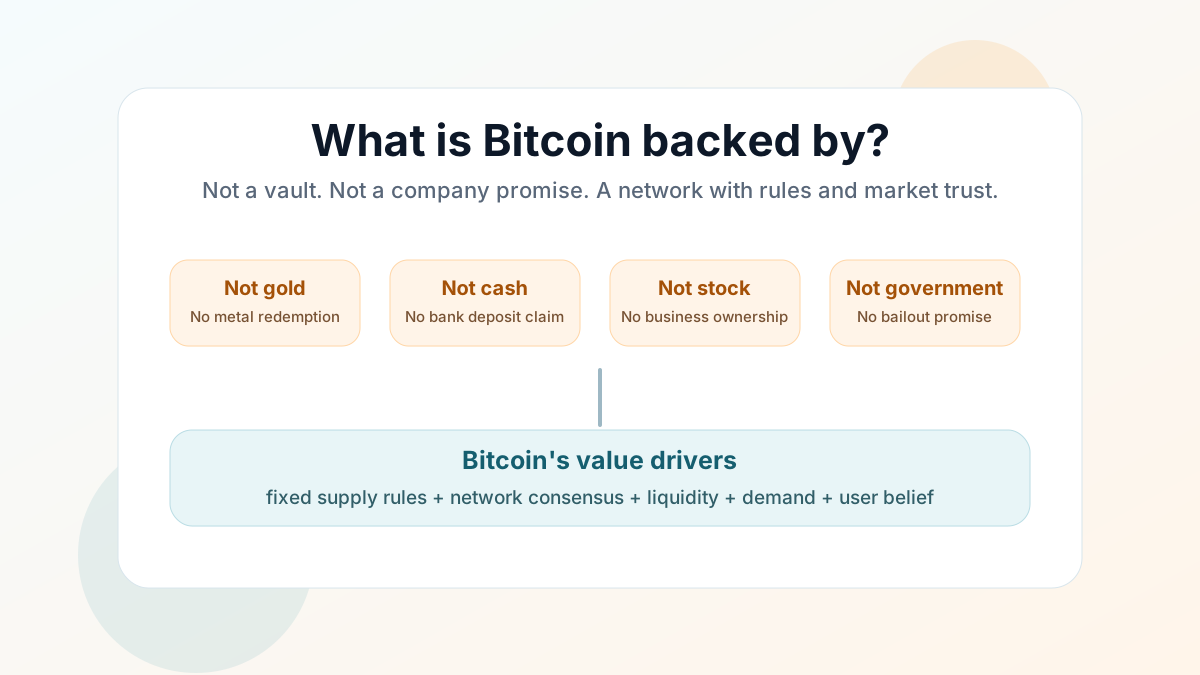
If you are asking what is Bitcoin backed by, the short answer is: Bitcoin is not backed by gold, cash, a company, or a government. Its value depends on public rules, limited supply, network participation, liquidity, market demand, and user trust.
That makes Bitcoin different from a dollar, a stock, a gold claim, or a stablecoin. It also means there is no guaranteed price floor if demand and trust weaken.
The useful question is not only whether Bitcoin has traditional backing. It is what kind of support it has instead, and what risks that support does not remove.

Quick Answer: Bitcoin Is Not Backed by Gold, Cash, a Company, or a Government
Bitcoin is not redeemable for gold, not a bank deposit, not a share of a company, and not guaranteed by a central bank or government.
What it has instead is a rule-based network: a fixed issuance schedule, public transaction verification, miners, nodes, wallets, markets, and people who choose to use or hold BTC. Those pieces can support value, but they do not promise future demand or protect you from losses.
So the beginner version is simple: Bitcoin is not traditionally backed. It is a scarce digital network asset whose price depends on whether the market continues to value its rules and usefulness.
What "Backed By" Means in Money and Assets
Before Bitcoin can make sense, the word backed needs a little cleaning. People use it for several different things.
Sometimes backed by means redeemable. A historical gold-backed note could be exchanged, under the rules of that system, for a certain amount of gold. Sometimes it means legally supported, as with government-issued fiat money. Sometimes it means ownership, as with a stock share connected to a business. Sometimes it means reserves, as with a stablecoin issuer claiming to hold assets against tokens.
Those are not the same bucket.
Bitcoin sits in a different bucket. It does not give the holder a claim on a company's assets. It does not promise conversion into gold. It does not come with deposit insurance. Holding BTC means holding units on a public network whose rules are enforced by software and economic participation, not by an issuer promising redemption.
So the real question becomes: if Bitcoin has no traditional backing, what gives it any value at all?
Bitcoin's Value Comes From Scarcity, Consensus, Liquidity, and Market Trust
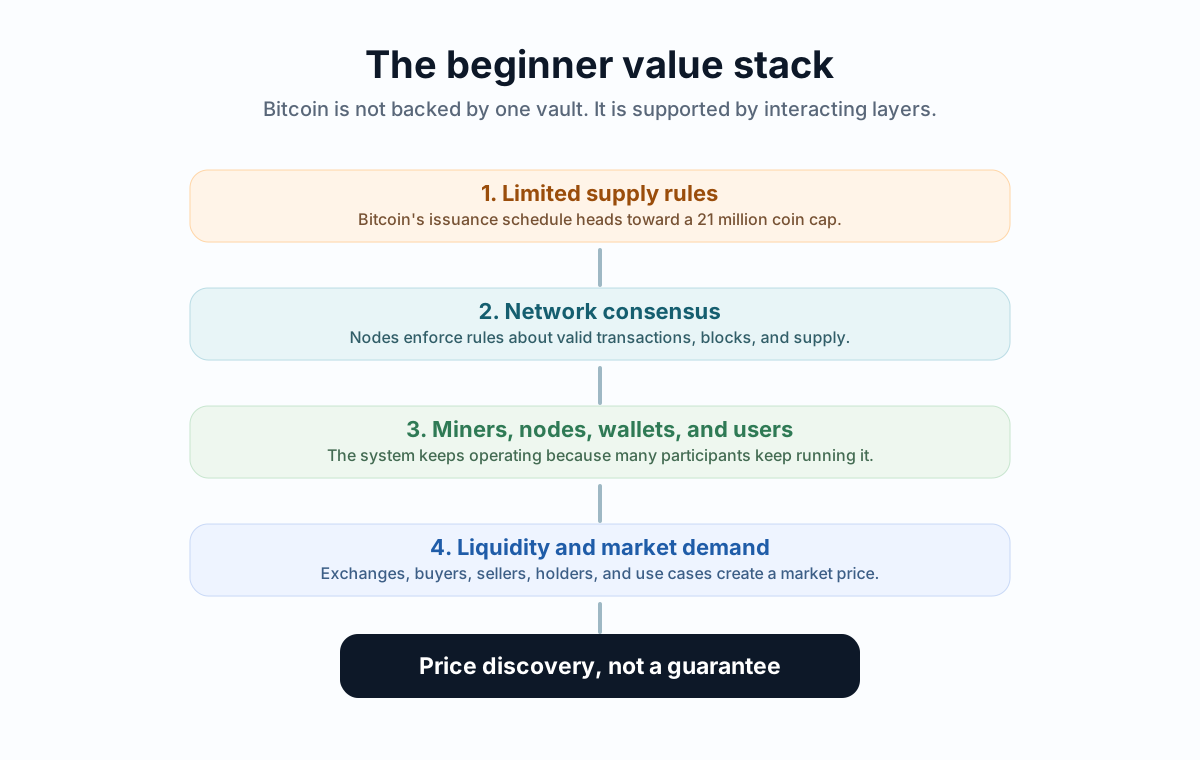
Bitcoin's price is not created by one magic ingredient. It is more like a stack. Remove enough pieces from the stack and the whole thing starts making nervous noises.
Limited Supply Creates Digital Scarcity
Bitcoin's protocol has a supply schedule. New bitcoin is issued through mining rewards, those rewards decline over time, and the total supply is designed to approach 21 million BTC.
Scarcity matters because people cannot simply vote to create unlimited new BTC inside the existing Bitcoin rules without changing the system people agree to run. But scarcity alone is not value. A rock you name Kevin can also be scarce. The market still has to care about Kevin.
Bitcoin scarcity matters only because people also value the network, the asset's history, its liquidity, and the expectation that other participants will continue to recognize the same rules.
Network Consensus Keeps the Bitcoin Ledger Running
When beginners ask how does Bitcoin work, the short version is that Bitcoin is a shared ledger maintained by a peer-to-peer network. Nodes check whether transactions and blocks follow the rules. Miners compete to add new blocks. Wallets create and sign transactions. Users choose which software and rules they accept.
This is not the same as trusting one company database. It is a system where many independent participants can verify the same history.
That does not make it risk-free. It means the trust model is different: less "trust this issuer" and more "verify these public rules and the network enforcing them."
Miners and Nodes Help Secure the Network
Miners use computing power to compete for the next block reward and transaction fees. Nodes check the blocks miners produce. If a miner creates an invalid block, honest nodes can reject it.
For a beginner, the key is not to memorize every technical detail. The key is to understand that Bitcoin's security is not a person in an office stamping transactions approved. It is a process involving software rules, economic incentives, public verification, and a lot of machines arguing in the strict language of math.
Market Demand and Liquidity Create the Price
Bitcoin's price comes from markets. Buyers and sellers meet on exchanges, over-the-counter desks, apps, funds, and other venues. The price changes when supply, demand, expectations, liquidity, news, leverage, regulation, macro conditions, and human emotion collide in public.
That means Bitcoin's market price is not a promise. It is a live negotiation.
If many people want BTC and few people are willing to sell at lower prices, the price can rise. If demand weakens, sellers rush out, leverage unwinds, or trust falls, the price can drop sharply. The rules can be stable while the price is chaotic. This is a deeply annoying thing for a beginner brain, but it is important.
Math, Energy, and Blockchain Are Not Traditional Backing
You may hear that Bitcoin is backed by math, energy, code, or the blockchain. These phrases can be useful shorthand, but they can also confuse the issue.
Math helps define and verify the system. Energy helps make mining costly and competitive. The blockchain records transaction history. Code expresses the rules. But none of those things is a vault of redeemable assets. You cannot take one BTC to the Bitcoin office and exchange it for a fixed box of math.
A better wording is: Bitcoin is not traditionally backed; it is supported by rules, verification, security costs, network effects, liquidity, and market belief.
Bitcoin Compared With Fiat Money, Gold, Stocks, and Stablecoins
Most confusion comes from comparing Bitcoin to the wrong neighbor. Bitcoin is not a dollar, not a gold bar, not a stock, and not a stablecoin. It borrows little pieces of intuition from each, then refuses to fully become any of them, which is impolite but educational.

Comparison Table: What Actually Backs Each Asset
Asset type | What people usually mean by backing | What the holder owns or relies on | Main beginner risk |
|---|---|---|---|
Fiat money | Government issuance, legal tender status, central bank system, public trust | A currency accepted for payments, debts, taxes, and savings under that monetary system | Inflation, policy mistakes, loss of purchasing power, banking or payment restrictions |
Gold | Physical scarcity, mining cost, history, jewelry and industrial demand, monetary tradition | A physical commodity, or a claim through a product that tracks or holds gold | Storage, theft, product structure, price volatility, no yield |
Stock | Business assets, cash flows, profits, legal ownership rights | Equity ownership in a company, depending on share class and legal structure | Business failure, dilution, valuation risk, market volatility |
Stablecoin | Issuer reserves, redemption promise, audits or attestations, legal structure | A token that depends on issuer solvency, reserve quality, and redemption rules | Issuer risk, reserve risk, regulatory risk, depeg risk |
Bitcoin | No traditional backing; value depends on public rules, scarcity, network security, liquidity, demand, and trust | BTC on the Bitcoin network, controlled by whoever controls the relevant private keys or custody account | Severe price volatility, no bailout, custody mistakes, scams, regulatory uncertainty |
Fiat Money Relies on Government and Central Bank Trust
Modern U.S. dollars are not redeemable for gold or silver. They work as fiat money: money issued by a government and used because of law, institutions, taxation, payment networks, economic scale, and public trust.
This is not the same as being worthless. It is a different kind of backing: institutional and legal, not metal-in-a-vault. Bitcoin has no central bank doing that job.
Gold Relies on Physical Scarcity and Historical Demand
Gold has physical scarcity, a long cultural history, jewelry demand, industrial uses, and deep global markets. It does not need a CEO to make it shiny.
But gold is not guaranteed either. Its price can move, it can be hard to store securely, and gold-linked financial products can introduce their own product risks. Gold teaches a useful lesson for Bitcoin: scarcity can matter, but demand, liquidity, and trust still matter too.
Stocks Represent Ownership in a Business
A stock is different. A share may represent ownership in a company, with a legal claim on some combination of future profits, voting rights, assets, or liquidation value, depending on the structure. That is one reason a Bitcoin ETF is also different from owning BTC directly.
Bitcoin has no income statement. No board meeting. No customer support line called "Bitcoin Incorporated." BTC holders do not own a slice of a company. They own or control units on a network.
Stablecoins Rely on Reserve Assets and Issuer Trust
Stablecoins are often closer to what beginners imagine when they hear "backed crypto." A stablecoin issuer may say each token is supported by cash, Treasury bills, or other reserve assets.
That makes stablecoins different from Bitcoin. A stablecoin depends heavily on the issuer, reserve quality, redemption rules, audits or attestations, banking access, and regulation. Bitcoin does not try to hold a one-dollar price and does not rely on one issuer promising redemption.
Bitcoin Relies on Network Rules and Market Demand
Bitcoin's base layer is a set of rules people choose to run and verify. The market decides what BTC is worth against dollars, euros, gold, goods, services, or anything else.
This is both the interesting part and the risky part. There is no single institution to rescue the price. There is also no single institution that can casually print more BTC inside the current rules because it had a stressful quarter.
Beginner Risk Boundaries Before You Buy
The phrase "not backed by anything" can be used as a lazy insult. The phrase "backed by math" can be used as lazy hype. Beginners should reject both and look at the risk boundaries.
The beginner rule: if you cannot explain what could make Bitcoin lose value, you are not ready to treat it as safe. Understanding the positive case is only half the job. The other half is knowing where the floor might not exist.
No Government Guarantee Means No Bailout
If your bank deposit is covered by a government insurance program, that is a specific legal protection. Bitcoin does not come with that protection. Crypto held through a platform can also involve platform failure, hacking, account freezes, withdrawal limits, or bankruptcy risk, which is why beginners should learn how to evaluate a Bitcoin platform before using one.
If you self-custody BTC, you remove some platform risk but take on private-key risk. Lose the recovery phrase or expose it to a scammer, and there may be no reversal button. The reversal button has been fired into space.
Scarcity Does Not Guarantee Future Price Gains
Scarcity is only useful when demand exists. A maximum supply can make Bitcoin resistant to unlimited monetary expansion inside its own rules, but it cannot force people to want BTC at a higher price.
That distinction is the fence between education and salesmanship. Bitcoin's supply design is important. It is not a promise that the chart owes you anything.
Price Volatility Can Be Severe
Bitcoin has had large price increases and large drawdowns. A beginner should assume that sharp movement is normal, not a malfunction. The market can move faster than your emotions can process, which is rude but historically common.
This matters before buying because the question is not only "Do I understand Bitcoin's backing?" It is also "Can I handle owning something whose market price may behave like it found three espressos and a trampoline?"
How to Continue Learning Before Buying Bitcoin
The next step is not necessarily buying. The next step is removing fog.
How Bitcoin Works at a Basic Level
Start with How Does Bitcoin Work? if the network still feels abstract. The backing question becomes easier after you understand transactions, blocks, mining, nodes, private keys, and why verification matters.
What Bitcoin Is Used For
If you are wondering what is Bitcoin used for, think in categories: long-term holding, peer-to-peer transfer, savings experiments, payments in some settings, collateral in some financial products, and institutional market exposure through products such as Bitcoin ETFs. Each use has different tradeoffs.
A use case does not make an asset safe by itself. It only explains why some people demand it.
How to Buy Bitcoin Safely
If you later decide to compare buying routes, use How to Buy Bitcoin as the practical starting point. If you plan to hold BTC yourself, read Bitcoin Wallets and Storage before moving anything to a wallet.
Buying before understanding custody is like signing for a safe before learning where the key goes. It is better to reverse that order.
FAQ
Is Bitcoin Backed by Gold?
No. Bitcoin is not backed by gold and is not redeemable for gold. It has a fixed supply schedule and a market price, but it is not a gold certificate or a claim on a metal reserve.
Is Bitcoin Backed by the Government?
No. Bitcoin is not issued or guaranteed by a government. That means there is no central bank support, no government price floor, and no ordinary deposit-insurance protection for BTC itself.
What Backs Bitcoin?
Bitcoin is not backed in the traditional reserve or issuer sense. It is supported by public software rules, limited supply, network consensus, mining incentives, node verification, liquidity, and market demand. Those can support a market price, but they do not guarantee one.
What Gives Bitcoin Value?
Bitcoin has value when people demand BTC because they value its scarcity, transferability, censorship-resistant design, liquidity, brand, history, or role as a non-sovereign digital asset. The market price changes as that demand changes.
Can Bitcoin Go to Zero?
It is possible for Bitcoin to lose most or all market value if demand collapsed, the network lost trust, a severe technical or security failure occurred, regulation or market structure changed dramatically, or people simply stopped valuing it. Nobody should treat Bitcoin's future price as guaranteed.
Is Bitcoin Backed by Elon Musk or Any Celebrity?
No. Celebrity attention is not backing. A public figure can influence conversation or short-term sentiment, but Bitcoin is not a claim on any celebrity, company, or personal promise.
Is a Bitcoin ETF Backed by Bitcoin?
Some spot Bitcoin exchange-traded products seek exposure by holding bitcoin through a custody structure, but an ETF or trust share is not the same as holding BTC in your own wallet. Read the product documents and understand fees, custody, tracking, and broker rules.
Risk Disclaimer
This article is for beginner education only. It is not financial, investment, tax, legal, or security advice. Bitcoin can be highly volatile, and you can lose money. Bitcoin is not backed by a government, bank, company, gold reserve, or deposit-insurance program. Crypto platforms, wallets, ETFs, and other products can involve different risks. Always verify current official information and consider your own situation before making financial decisions.
Editorial Attribution
Written by Alex Chen. Reviewed by Jordan Blake for factual accuracy, clarity, and beginner safety.