
A Bitcoin faucet is a website or app feature that offers tiny Bitcoin rewards for small actions, like viewing ads, completing tasks, solving a prompt, or checking in repeatedly.
The word that does most of the damage is not "faucet." It is "free."

Free Bitcoin offers can still come with a price.
Free Bitcoin can sound like a harmless way to learn. Sometimes a faucet may really offer tiny rewards. But if the reward is small and the page asks for your trust, your attention, your personal data, a wallet download, a deposit, or anything close to a seed phrase, the free part has quietly left the room.
Bitcoin faucets in one sentence
A Bitcoin faucet is a reward page that gives very small amounts of Bitcoin, usually in sats, after a user completes a small action.
That is the clean definition. The messy part is the surrounding machinery.
A faucet might be tied to ads, games, signups, app installs, referral programs, email capture, or other tasks. Some are ordinary low-value reward pages. Some are low-quality distractions. Some are traps wearing a tiny Bitcoin hat.
The beginner mistake is to ask only, "Will it give me Bitcoin?"
The better question is: what am I being asked to give up for this tiny reward?
How faucet rewards usually work
Faucet rewards are usually tiny because the page is not trying to make you rich. It is usually trying to buy something from you: attention, ad views, registrations, referrals, or repeated visits.
That is why faucet rewards are often described in sats, the smallest unit of Bitcoin. A reward like 50 sats may look more exciting than a tiny fraction of BTC, but the unit does not change the basic reality: the reward is small.
No real-time dollar conversion is needed here. The exact value changes with Bitcoin's price, and this article is not a payout calculator. The useful habit is simpler: when a reward is tiny, the safety cost matters more.
If a page asks for a lot of information, a download, a payment, or account access in exchange for a tiny reward, the exchange is already upside down.
Why free Bitcoin can become expensive
"Free" can still be expensive when the price is hidden.
The price might be your time. That is boring but survivable.
The price might be your email, phone number, wallet address, device permissions, or attention trapped inside an ad maze. That is more serious.
The price might be worse: a fake wallet download, a support impersonator, a request for a seed phrase, or a "deposit first to unlock rewards" promise. Bitcoin.org's scam guidance warns beginners to treat private-key, seed-phrase, fake support, malware, and giveaway-style traps seriously. The FTC also warns that crypto scammers often use free-money or pay-first promises to pull people into unsafe actions.
This is the part beginners need to hold onto: a faucet reward can be real and still not be worth the risk. A candy-size reward does not make a strange website trustworthy.
Common faucet and giveaway red flags
Most risky faucet pages do not announce themselves with a red banner that says, "Hello, this is the bad part."
They look like small steps.
One more form. One more code. One more download. One small deposit. One support chat. One wallet connection. The same caution that helps with fake messages and codes also helps here: do not let a small prompt become an automatic action.
Use the table as a stop sign:
Red flag | Why it matters | Beginner action |
|---|---|---|
Seed phrase or private key request | Gives control of funds away | Leave immediately |
"Deposit first" promise | Common activation scam pattern | Do not pay |
Fake support contact | Can lead to account or wallet theft | Use official channels only |
Too-good rewards | Usually not realistic for tiny tasks | Treat as suspicious |
Wallet download link | May point to malware or fake apps | Use official wallet sources |
Pressure to act now | Blocks careful checking | Pause and verify |
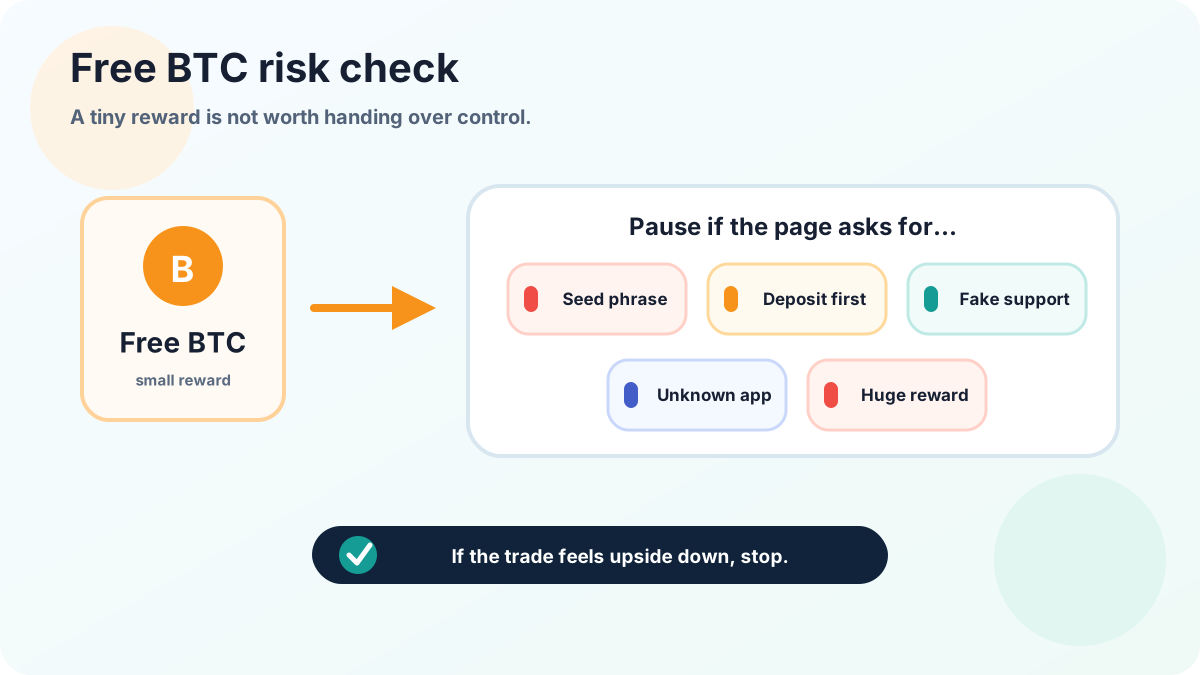
A tiny reward is not worth handing over control.
The rule is not that every faucet page is a scam. The rule is that a beginner should not let a tiny reward override basic safety checks.
What beginners should never share
Some information is not "signup information." It is control information.
Never enter a seed phrase, private key, recovery phrase, one-time login code, two-factor code, or remote-access approval into a faucet page or a support chat connected to a faucet offer.
A wallet address is different. A public receiving address is meant to receive funds, but beginners should still be careful about where they paste it, how much activity it reveals, and whether the page is using it as bait for the next step.
The sharpest line is this:
If a page says it needs your seed phrase or private key to send you free Bitcoin, it is not helping you receive Bitcoin. It is asking for the keys to the house.
This is also why seed phrases should not end up in screenshots, cloud folders, or random forms. If that habit is still fuzzy, the guide on seed phrases in photos or cloud drives is the safer place to slow down.
Safer ways to learn Bitcoin before buying
If your real goal is to learn Bitcoin, chasing free Bitcoin is usually a noisy classroom.
A quieter path is better:
Learn what Bitcoin risk means before you buy anything.
Learn what sats are, so tiny rewards do not look larger than they are.
Learn how a normal buying path works before trusting a reward page.
Learn what to check before clicking buy or entering payment information.
Learn why seed phrases should not live in screenshots, cloud drives, or random forms.
That path is less exciting than a "claim free BTC now" button.
That is the point.
Good beginner Bitcoin education should make fewer buttons feel urgent.
FAQ
Do Bitcoin faucets really give free Bitcoin?
Some faucet pages may give tiny Bitcoin rewards, often in sats. That does not make every faucet safe, worthwhile, or trustworthy. The reward size should be weighed against the information, time, and security risk involved.
Is a Bitcoin faucet a scam?
Not automatically. But faucet-style pages are easy places for scam patterns to appear: fake giveaways, deposit-first promises, fake support, unknown downloads, or requests for private wallet information.
What is the difference between a faucet, an airdrop, and a giveaway?
A faucet usually gives small repeated rewards for simple actions. An airdrop is often tied to a project distribution. A giveaway is a broader promotional claim. All three can be legitimate in some contexts, but all three can also be used as scam packaging.
Is 50 sats worth chasing?
50 sats is a tiny Bitcoin-denominated amount. The exact value changes with BTC price, so the better question is whether the page is asking for anything risky in exchange for that tiny reward.
Can I use a separate wallet address for faucets?
Using separation can reduce some privacy and organization problems, but it does not make an unsafe page safe. Never share a seed phrase, private key, recovery phrase, or login code with a faucet page.
What should I do if a faucet asks me to deposit first?
Stop. A "deposit first to unlock rewards" promise is a serious red flag. Do not pay, do not connect a wallet, and do not continue through pressure screens.
Official References
Risk Disclaimer
This article is for beginner education only. It is not financial, investment, legal, tax, custody, or security advice. Bitcoin transactions can be irreversible, Bitcoin is volatile, and wallet mistakes can cause permanent loss. Wallet software, platform rules, withdrawal support, security features, and recovery processes can change. Check official wallet and platform documentation before acting, and use qualified professional help when needed.
Editorial Attribution
Written by Alex Chen. Reviewed by Jordan Blake for factual accuracy, clarity, and beginner safety.