
A Bitcoin fork is what happens when Bitcoin's shared history or shared rules reach a branch point.
That sounds technical because it is technical. But the beginner version is simpler: Bitcoin works because a lot of people and machines agree on which rules count. A fork is what happens when the rule path changes, or when different groups stop following the same path.
The confusing part is that one word has to do too many jobs.
Sometimes "fork" means a software or rule change. Sometimes it means a split in blockchain history. Sometimes it points to a separate coin that came from a past disagreement, like Bitcoin Cash.
Those are related ideas. They are not the same button.

Similar names can point to different asset paths.
Bitcoin fork in one sentence
A Bitcoin fork is a change or split in Bitcoin's rules or blockchain history that can make different versions of the network, software, or assets move in different directions.
Think of Bitcoin as two things at once:
a rulebook for what counts as valid Bitcoin activity
a history book of confirmed blocks and transactions
Most of the time, everyone is trying to keep reading the same history book with the same rulebook beside it.
A fork is when the reading path branches.
That branch does not automatically mean "new free coins." It does not automatically mean your BTC changed into something else. It does not automatically mean Bitcoin broke.
It means the rules, the history path, or the community using them reached a point where one path was no longer the only path.
The practical beginner question is not "Which side should I cheer for?"
The practical question is: "Am I dealing with BTC, or with something that only has Bitcoin in the name?"
Why forks happen
Bitcoin is not a company with one giant update button in a conference room. After Satoshi Nakamoto released Bitcoin, the system did not become a normal product with one owner changing rules for everyone.
It is a network of people running software that checks whether blocks and transactions follow Bitcoin's rules. A Bitcoin full node is one of the machines that checks those rules for itself. That little fact matters because forks are rule problems before they are name problems.
Forks can happen for a few broad reasons:
developers propose a change to the software
users and businesses decide whether to run software with that change
miners produce blocks under rules the network will or will not accept
different groups disagree about which rule set should continue
If the change is compatible enough with the existing rules, the network may continue without creating a separate asset.
If the change is incompatible and different groups keep supporting different histories, the road can split more dramatically.
This is why fork language gets emotional. A fork is not only a technical event. It can also be a disagreement about what Bitcoin should be.
For a beginner, the emotional argument is usually less useful than the label check.
BTC is BTC. A forked coin is not automatically BTC.
Hard fork vs. soft fork
The two phrases beginners meet most often are hard fork and soft fork.
Here is the clean version:
A soft fork usually tightens or changes rules in a way that can remain compatible with older rules in a limited sense.
A hard fork changes rules in a way that older software will not treat as the same valid path.
The second sentence is the one that causes the expensive confusion.
If a hard fork creates a lasting split and different communities keep using different chains, a separate asset may exist. That asset may have a similar name, a shared history before the fork, or a familiar logo style.
None of that makes it BTC.
Concept | Beginner meaning | What to check |
|---|---|---|
Soft fork | A rule change that can stay compatible with older rules in a limited way | Do not treat it as a new coin by default |
Hard fork | A rule change that can create an incompatible split if groups disagree | Check the asset ticker and network |
Forked coin | A separate asset or network that came from fork history | Do not send it as BTC |
Exchange ticker | The label a platform uses, such as BTC or BCH | Make sure it matches what you intend |
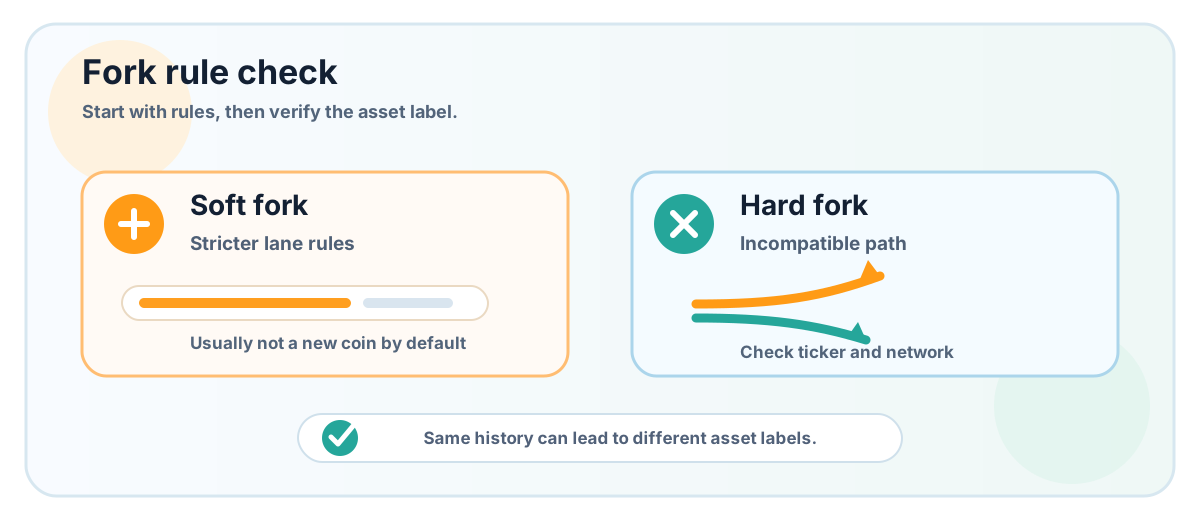
The practical question is whether the rules and asset label still match what you intend.
One way to picture it:
A soft fork is like narrowing a road lane while traffic still moves on the same road.
A hard fork is like building a road that older maps cannot read. If everyone moves to the new map together, the story is one thing. If different groups keep using different maps, the story becomes two roads.
That is why the word "fork" needs caution. It describes a branching mechanism. It does not tell you which asset you are holding.
Forked coins are not the same as BTC
Bitcoin Cash is the beginner example because the name is almost designed to make a normal person squint.
Bitcoin Cash, or BCH, came from Bitcoin fork history. It is a separate asset from Bitcoin BTC.
That means a few things:
BTC and BCH are not interchangeable labels.
A wallet or exchange may support one, both, or neither in a specific flow.
A receiving address or platform rule that is correct for one asset may not be correct for the other.
Similar names do not make transfer rules forgiving.
This is the same naming trap that appears in other parts of crypto: a word looks familiar, so the brain relaxes. The brain should not relax. The brain should become a tiny label inspector with a clipboard.
The full BTC and BCH distinction belongs in the Bitcoin Cash guide. Here, the rule is narrower:
Fork history can explain why names are related. It does not make the assets the same.
What beginners should check before buying or sending
Fork confusion becomes dangerous when it leaves the vocabulary zone and enters the button zone.
Before buying, check:
the full asset name
the ticker, such as BTC or BCH
whether the platform page is about Bitcoin or a forked coin
whether the page is using "Bitcoin" as history, branding, or the actual asset
Before sending, check:
the asset you are sending
the network or chain selected in the wallet or platform
whether the receiving wallet or platform supports that exact asset and network
whether the receiving address belongs to the right receiving flow
whether official platform rules mention unsupported deposits or wrong-network transfers
The boring check is the useful check.
Forks can be historically interesting. They can also be politically interesting, technically interesting, and internet-argument interesting.
But at the moment you are buying or sending, the interesting part becomes much smaller:
Does the label match the thing I intend to move?
If the answer is not clearly yes, pause.
FAQ
Does every Bitcoin fork create a new coin?
No. Some forks or upgrades do not create a lasting separate coin. A fork can describe a rule change, a temporary chain branch, or a permanent split. Beginners should not assume that every fork means a new asset or free coins.
What is the difference between a hard fork and a soft fork?
A soft fork usually changes rules in a way that can remain compatible with older rules in a limited way. A hard fork changes rules in a way older software will not treat as the same valid path. If groups keep supporting different paths after an incompatible split, a separate asset can exist.
Is Bitcoin Cash the same as Bitcoin?
No. Bitcoin Cash uses the ticker BCH. Bitcoin uses the ticker BTC. BCH came from Bitcoin fork history, but it is a separate asset. Similar names do not make the coins or transfer rules interchangeable.
Does a Bitcoin fork change the BTC in my wallet?
A fork does not automatically turn BTC into a different asset or erase a balance by itself. Wallet and platform behavior can still vary, especially around support for forked assets, display rules, and deposits. Check official wallet or platform documentation before acting.
Do I get free coins after a Bitcoin fork?
Do not assume that. Forked-asset access depends on many details: the fork, the wallet, the platform, custody rules, private-key control, and whether anyone supports the asset. Treat "free fork coins" claims with caution.
Is a hard fork bad?
Not automatically. "Hard fork" describes an incompatible rule change. The risk for beginners is not the phrase itself. The risk is confusing the resulting asset, ticker, network, or support rules.
What should I check before sending BTC or a forked coin?
Check the asset name, ticker, network, receiving address, and receiving platform support. If the wallet or platform mentions unsupported deposits or wrong-network transfers, read that before sending.
Official References
Risk Disclaimer
This article is for beginner education only. It is not financial, investment, legal, tax, custody, or security advice. Bitcoin transactions can be irreversible, Bitcoin is volatile, and wallet mistakes can cause permanent loss. Wallet software, platform rules, withdrawal support, security features, and recovery processes can change. Check official wallet and platform documentation before acting, and use qualified professional help when needed.
Editorial Attribution
Written by Alex Chen. Reviewed by Jordan Blake for factual accuracy, clarity, and beginner safety.