
If you are asking "how many Bitcoins are there," the short answer is that Bitcoin is designed to have a maximum supply of about 21 million BTC. Not all of that supply exists yet. New Bitcoin enters circulation through mining, and the amount created over time keeps slowing.
As of June 23, 2026, at Bitcoin block height 954,954, the block reward schedule implies that about 20.05 million BTC had been issued through mining, leaving roughly 0.95 million BTC left before the 21 million cap. That number changes as new blocks are mined, so any current supply figure should always be read with a date.
The important beginner point is this: Bitcoin's supply cap is a rule about issuance, not a promise about price. Scarcity can be part of why people discuss Bitcoin, but it does not remove volatility, wallet risk, platform risk, or the need to think carefully about risks before buying Bitcoin.

Bitcoin has a capped supply, but scarcity is not a price promise.
The short answer: Bitcoin's 21 million cap
Bitcoin's maximum supply is commonly described as about 21 million BTC. That does not mean 21 million spendable coins are sitting in one place, and it does not mean every coin is actively moving in the market.
For beginners, it helps to separate three ideas:
Term | What it means | Beginner note |
|---|---|---|
Maximum supply | The approximate upper limit of BTC that can ever be issued | About 21 million BTC |
Mined or issued supply | BTC already created through block rewards | Changes whenever new blocks are mined |
Active or spendable supply | Coins that owners can actually access and move | Lower than issued supply if some coins are lost |
Bitcoin.org's vocabulary describes halving as part of the schedule that keeps issuance predictable and tied to the 21 million coin limit. That makes the cap a supply rule, not a market prediction.
How newly mined Bitcoin enters circulation
New Bitcoin enters circulation through mining rewards. When miners add valid blocks to the Bitcoin blockchain, the block reward can include newly issued BTC plus transaction fees.
The Bitcoin whitepaper describes a basic incentive model in which new coins and fees help reward block creation. For this article, the important point is only the supply side: Bitcoin issuance follows rules. It is not created by a company deciding to print more coins, and it is not unlimited.
Mining rewards and halvings
A halving is the scheduled reduction of the new BTC subsidy in each block. In simple terms, the amount of new Bitcoin created per block gets cut in half roughly every 210,000 blocks.
That is why early Bitcoin supply grew faster, while later supply grows more slowly. Halvings are the reason the last part of Bitcoin's supply takes a very long time to mine.
This article only needs the supply idea. If a reader wants the mechanics of miners, blocks, and proof of work, that belongs in the SatoABC mining guide.
Why the last Bitcoin takes so long
Because the block subsidy keeps getting smaller, the remaining Bitcoin is not mined at a steady speed. The first millions of BTC were issued much faster than the final fractions will be.
That is why many explainers say the last Bitcoin is expected around 2140. This is an estimate based on the issuance schedule, not a promise of an exact calendar day. If tiny Bitcoin units feel confusing, the SatoABC satoshis guide explains how small BTC amounts are written.
How many Bitcoins are left to mine?
The dated figure above is only a snapshot. The cleaner beginner question is not just "how much bitcoin is left," but "how much bitcoin is left to mine."
That wording separates unissued Bitcoin from coins that may already exist but be lost, inactive, or held by someone else.
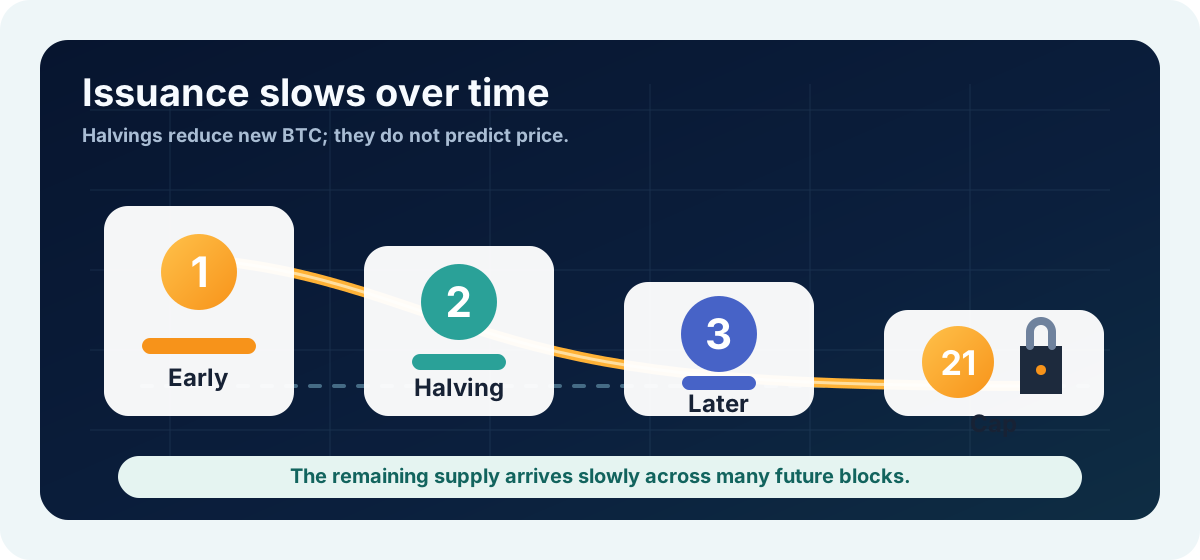
New Bitcoin issuance slows over time through halvings.
Do not get stuck on the last decimal place. For a beginner, the useful point is simpler: most Bitcoin has already been issued, and the rest arrives slowly as new blocks are mined.
Lost coins, circulating supply, and beginner confusion
Lost coins are Bitcoin that may no longer be accessible because the owner lost keys, destroyed backups, or can no longer sign a transaction. Those coins can remain visible on the blockchain, but no one may be able to move them.
Lost coins do not create more Bitcoin and do not raise the 21 million cap. They may reduce the amount of Bitcoin that is practically accessible, but the protocol supply limit is a separate idea.
This is why beginners should be careful with phrases like "how many Bitcoins are there." The answer depends on whether you mean maximum supply, mined supply, circulating supply, or coins people can actually access.
What scarcity does and does not mean
Bitcoin's capped supply is important, but it is not a price guarantee. A scarce thing can still fall in price, trade with high volatility, or be misunderstood by buyers.
The 21 million cap tells you something about issuance. It does not tell you what Bitcoin should be worth, when to buy, how much to buy, or whether a platform is safe to use. If you want the broader value discussion, keep it separate from this supply question and read SatoABC's guide to what Bitcoin is backed by.
For a beginner, the safer rule is: understand the supply rule, then separate it from buying decisions. Scarcity is one part of the Bitcoin story, not a complete investment thesis.
FAQ
How many Bitcoins can ever exist?
Bitcoin's maximum supply is commonly described as about 21 million BTC.
How many Bitcoins have been mined?
As of June 23, 2026, at block height 954,954, roughly 20.05 million BTC had been issued through mining. This figure changes as new blocks are mined.
How much Bitcoin is left to mine?
Using the same June 23, 2026 data point, roughly 0.95 million BTC remained to be mined before the 21 million cap.
When will all Bitcoin be mined?
Many explainers estimate around 2140, because block rewards keep shrinking through halvings. Treat that as an approximate schedule, not a precise date.
What happens after the last Bitcoin is mined?
New coin issuance would no longer be the miner subsidy. Transaction fees would remain part of miner incentives. Beginners should avoid assuming that the entire network suddenly stops.
Do lost coins change the 21 million cap?
No. Lost coins may reduce the amount people can actually access, but they do not increase the maximum supply.
Is Bitcoin's scarcity a price guarantee?
No. Scarcity does not guarantee a higher price, remove volatility, or make buying Bitcoin safe for every person.
Official References
Risk Disclaimer
This article is for beginner education only. It is not financial, investment, legal, tax, custody, or security advice. Bitcoin transactions can be irreversible, Bitcoin is volatile, and wallet mistakes can cause permanent loss. Wallet software, platform rules, withdrawal support, security features, and recovery processes can change. Check official wallet and platform documentation before acting, and use qualified professional help when needed.
Editorial Attribution
Written by Alex Chen. Reviewed by Jordan Blake for factual accuracy, clarity, and beginner safety.