
If you are asking who is Satoshi Nakamoto, the most honest beginner answer is: Satoshi Nakamoto is the name used by the person or group who published the Bitcoin whitepaper and helped launch the early Bitcoin software. The real-world identity has not been publicly proven.
That uncertainty is not a small footnote. It is part of why Satoshi stories attract rumors, false claims, wallet-balance guesses, and dramatic internet theories. A beginner does not need to solve the identity mystery to understand Bitcoin. A beginner needs to know which parts are established history, which parts are estimates, and which parts are unsupported noise.

Satoshi Nakamoto is a name on Bitcoin's early public record, not a confirmed public identity.
Known facts about Satoshi Nakamoto
The useful starting point is wonderfully plain: stick to the public record.
Here is what beginners can treat as known:
The name Satoshi Nakamoto appears on the Bitcoin whitepaper.
Satoshi released or helped release early Bitcoin software.
Satoshi communicated with early developers and users through public online channels and email.
Satoshi was involved during Bitcoin's earliest stage, when the network was small and experimental.
Satoshi eventually stepped back from public involvement.
No real-world identity has been proven publicly to the level a careful beginner should treat as settled fact.
That last point matters. Many articles start with the mystery and then drift into personality theater. It is more useful to separate the buckets first.
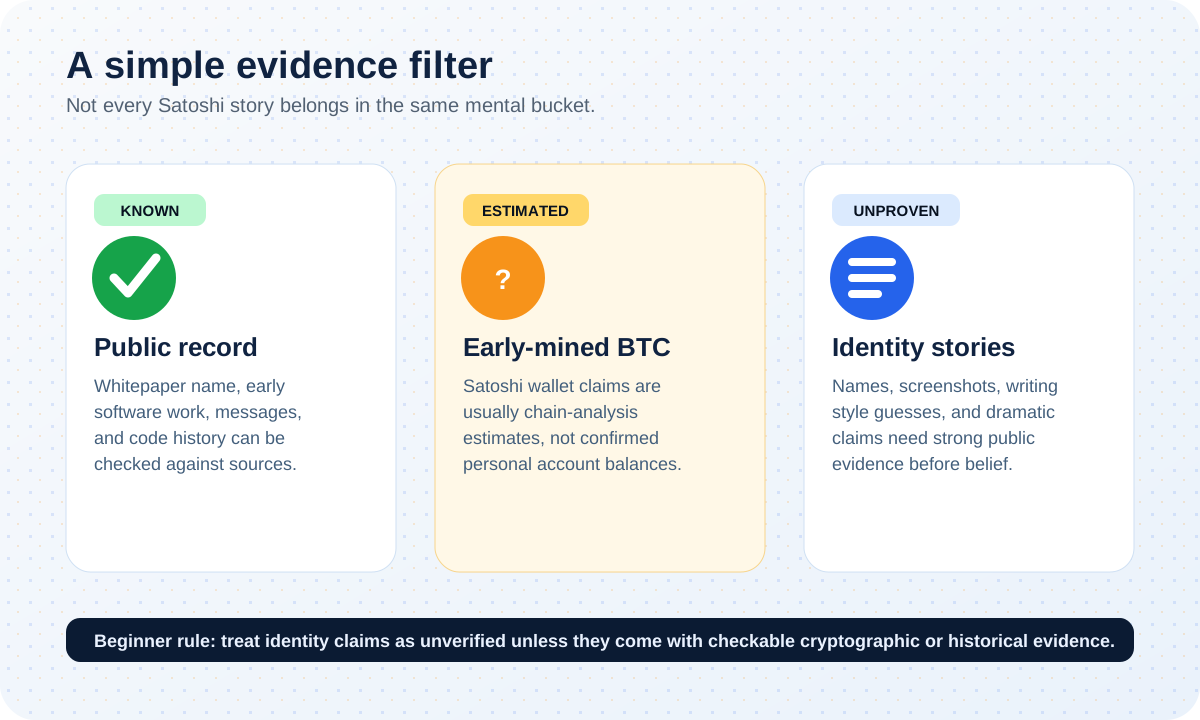
Use an evidence filter: public record, cautious estimates, and unproven identity claims are not the same thing.
Think of Satoshi knowledge in three layers:
Known facts: documents, code history, early communications, and the public timeline.
Reasonable but uncertain estimates: claims about early-mined coins or possible Satoshi-linked wallets based on blockchain analysis.
Unverified stories: identity claims, celebrity guesses, writing-style comparisons, and screenshots with no strong public proof.
Once those layers are separate, the topic becomes calmer. You can learn the important history without getting pulled into every new claim.
The Bitcoin whitepaper and early history
The Bitcoin whitepaper is the center of the Satoshi story. It described a peer-to-peer electronic cash system that did not require a bank or central operator to process transactions. For a beginner, the key idea is not that the paper was long or mystical. It was a design for a network where participants could verify rules instead of trusting one company.
Bitcoin's early history is easier to understand as a short public timeline:
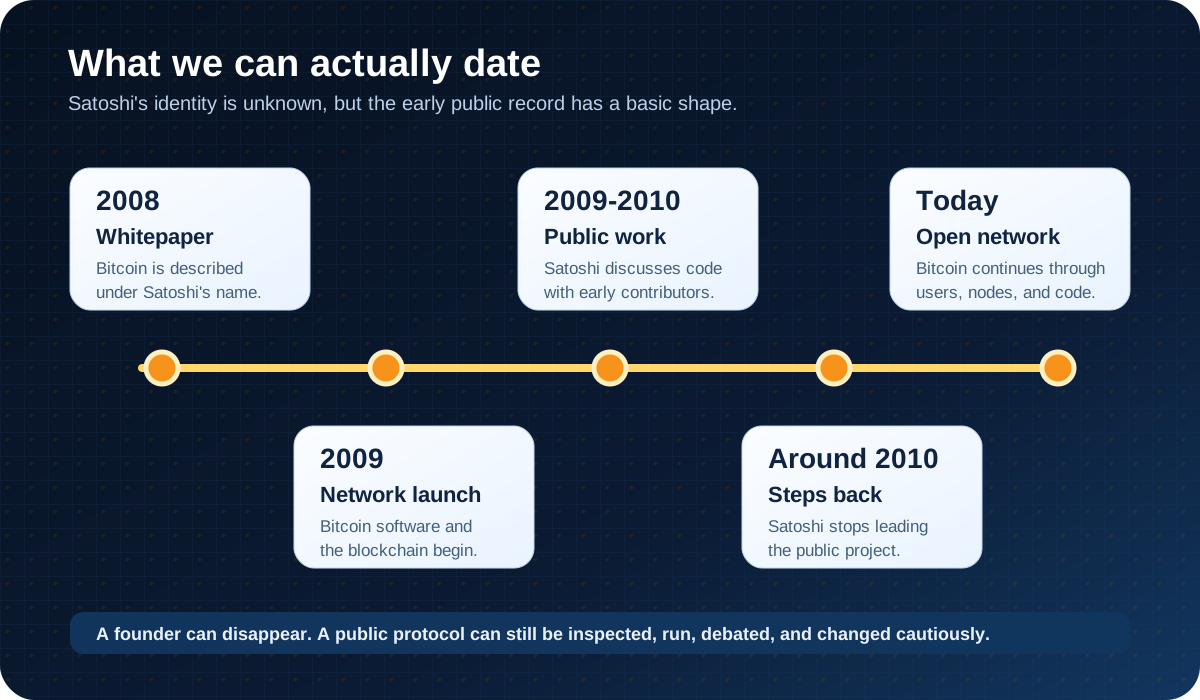
The early record has a simple shape: whitepaper, launch, collaboration, and then Satoshi stepping back.
The timeline does not answer who Satoshi was in private life. It answers something more useful: what role the Satoshi name played in Bitcoin's origin.
Satoshi was not a mascot added after Bitcoin became famous. The name is attached to the whitepaper, early software, early forum discussion, and the initial push that got the network running. But Bitcoin did not remain a one-person project. Over time, other developers, users, miners, node operators, businesses, and researchers became part of the system around it.
That transition is one reason the identity question is so strange. Satoshi is central to Bitcoin's origin story, but not central to every transaction happening now.
Why Satoshi's identity remains unknown
Nobody can honestly give a confirmed reason for Satoshi's anonymity unless they can prove they know Satoshi's private intent. The most careful answer is narrower: Satoshi used a pseudonym, did not publicly attach a verified legal identity to the project, and eventually stopped participating publicly.
People often suggest possible reasons:
Privacy.
Personal safety.
Avoiding fame.
Avoiding a single founder becoming the center of the system.
Legal or regulatory uncertainty around a new kind of money network.
The possibility that Satoshi was more than one person.
These are explanations people discuss. They are not confirmed motives.
That distinction is important because the internet loves to turn unknowns into stories. A blank space feels uncomfortable, so someone fills it. Sometimes the fill-in is harmless curiosity. Sometimes it becomes a confident claim about a specific person, a wallet, or a supposed market signal.
For a beginner, the healthier question is not, "Which Satoshi theory feels exciting?" It is, "What evidence would I need before believing this?"
Satoshi wallets and common rumors
Searches for Satoshi Nakamoto wallet or how much bitcoin does Satoshi have usually lead into a messy part of Bitcoin history. The short version is this: people have tried to estimate how much BTC may have been mined by Satoshi in Bitcoin's earliest period, but there is no official public list of "Satoshi's wallets" that proves a personal balance.
Some chain-analysis estimates suggest that early-mined coins associated with Satoshi could be very large. You may see figures around hundreds of thousands of BTC or more than one million BTC in articles, videos, and forums. Treat those as estimates based on assumptions, not as a confirmed bank-statement-style number.
There are two beginner traps here.
The first trap is treating a dormant early address as proof. An old address can be interesting, but age alone does not prove who controlled it.
The second trap is treating a wallet rumor as a prediction. If someone says, "Satoshi moved coins, so you must act now," slow down. Verify the transaction, check whether the address is actually linked by serious evidence, and remember that wallet rumors are often used to create urgency.
Here is a cleaner way to think about it:
A public Bitcoin address can be viewed on the blockchain.
Viewing an address does not tell you the owner's legal identity by itself.
Some early mining patterns may support estimates about Satoshi-linked coins.
Estimates are not the same as confirmed ownership.
A social media claim about a "Satoshi wallet" is not evidence by itself.
This is also a security point. You should never enter your seed phrase, private key, exchange login, or wallet backup into a website that claims it can check whether you own coins related to Satoshi. A public block explorer only needs public information such as an address or transaction ID. It does not need your private wallet secrets.
Why Bitcoin does not depend on knowing Satoshi
The Satoshi mystery can make Bitcoin sound like a magic trick: an unknown creator appears, launches a network, and disappears into the fog.
That is not the useful lesson.
The more useful lesson is that Bitcoin was designed so people can inspect and run rules. Today, Bitcoin does not work because users know Satoshi's passport name. It works, when it works, because software rules, cryptography, nodes, miners, wallets, and users interact in public.

Bitcoin's trust model is about public rules and network verification, not a founder's personal identity.
This does not mean Bitcoin has no risks. It has price volatility, user-error risk, custody risk, scam risk, software risk, and regulatory uncertainty. It also does not mean every Bitcoin-related project is trustworthy. Many things using Bitcoin language are not Bitcoin itself.
But the founder's anonymity is different from a hidden company owner. Bitcoin's core rules are publicly discussed and implemented in open-source software. People can run nodes, inspect transactions, debate changes, reject software they do not want, and choose how they custody their funds.
That is the beginner bridge from "Who made this?" to "How does this work?"
What beginners should take away
If you are new to Bitcoin, Satoshi Nakamoto is worth understanding, but not worshiping.
The name matters because it is attached to Bitcoin's invention and early launch. The mystery matters because it shows how easily people turn missing information into stories. The disappearance matters because it forces a deeper question: can a money network keep operating without a public founder standing in the middle?
For your learning path, keep these points:
Satoshi Nakamoto is the pseudonymous creator name behind Bitcoin's early public record.
The real identity is not publicly proven.
The whitepaper and early software history are more reliable than identity rumors.
Satoshi wallet claims should be treated carefully unless the evidence is clear and checkable.
Bitcoin today is better understood through its rules, nodes, mining, wallets, and user behavior than through founder speculation.
The identity mystery is interesting. But for a beginner, the practical path is to learn the system that remained after the mystery walked offstage.
FAQ
Is Satoshi Nakamoto a real person?
Satoshi Nakamoto may have been one person or a group using a single name. The public record does not prove a real-world identity. A careful wording is to describe Satoshi as the pseudonymous creator name associated with Bitcoin's whitepaper and early software.
How much Bitcoin does Satoshi own?
No confirmed public balance exists for Satoshi. Some researchers and articles estimate that Satoshi-linked early mining could involve a very large amount of BTC, sometimes described as hundreds of thousands or more than one million BTC. Those figures depend on chain-analysis assumptions and should not be treated as a confirmed wallet statement.
Does Satoshi control Bitcoin today?
There is no good reason for beginners to think Satoshi controls Bitcoin today as a central operator. Bitcoin changes through software, nodes, miners, developers, users, and economic consensus. A founder's identity is not the mechanism that validates transactions.
What is the Satoshi Nakamoto wallet?
There is no single officially confirmed "Satoshi Nakamoto wallet" for beginners to rely on. There are early addresses and mining-pattern estimates that researchers discuss, but a public address alone does not prove a legal identity.
Why did Satoshi Nakamoto stay anonymous?
The reason is not publicly confirmed. People suggest privacy, safety, decentralization, legal uncertainty, or the possibility that Satoshi was a group. Those are theories, not proven motives.
Should beginners care who Satoshi Nakamoto is?
Beginners should know the basic history, but they should not rely on identity theories to make financial decisions. It is more useful to learn how Bitcoin transactions, mining, wallets, and private keys work.
Can someone prove they are Satoshi?
In theory, strong proof would need evidence that careful experts can verify, such as control of certain early cryptographic keys or other historically meaningful proof. A media claim, screenshot, writing-style guess, or social post is not enough by itself.
Related SatoABC Guides
Risk Disclaimer
This article is for beginner education only. It is not financial, legal, tax, or investment advice. Bitcoin and crypto-related services can involve price volatility, fraud risk, custody risk, irreversible transactions, account restrictions, and changing laws or platform rules. Do not make financial decisions based on Satoshi identity rumors, wallet rumors, or social media claims.
Editorial Attribution
Written by Alex Chen. Reviewed by Jordan Blake for factual accuracy, clarity, and beginner safety.