
An onchain wallet is not just "a wallet app." It is a wallet setup used for Bitcoin transactions that settle through Bitcoin's base blockchain, instead of staying only as an exchange balance or moving through a Lightning payment path.
If you are still building the larger Bitcoin wallets and storage map, this is one of the first labels to separate. Exchange balance, on-chain wallet, and Lightning payment path are not three names for the same room.

An onchain wallet is a different path from an exchange balance or Lightning payment.
That sounds like a small wording difference. It is not.
For a beginner, the word onchain changes the map. It affects what kind of address you use, where the transaction can be seen, who controls the backup, what mistakes can become permanent, and which help screen you should read before withdrawing.
Onchain wallet in one sentence
An onchain wallet is a Bitcoin wallet used to send and receive Bitcoin through on-chain transactions recorded on the Bitcoin blockchain.
That does not automatically mean every product using the word "onchain" works the same way. Some wallets are self-custody wallets, where you control the backup and private keys. Some services may use wallet-like language while still controlling parts of the account system for you.
The beginner question is not only "Do I have a wallet?" It is: who controls access, what payment path am I using, and what happens if I make a mistake?
An exchange account can show a Bitcoin balance before any withdrawal happens.
An onchain wallet uses Bitcoin's on-chain transaction path.
A Lightning wallet uses a different payment path designed for Lightning payments.
Those three things can all involve Bitcoin, but they are not the same room.
What "on-chain" means for a wallet
"On-chain" means the transaction uses Bitcoin's base blockchain path. Bitcoin.org explains that Bitcoin transactions are included in the blockchain, which is shared across the network.
For a wallet user, this has a practical meaning: an on-chain send is not just a number moving inside one company's account database. It is a Bitcoin transaction that has to use a compatible Bitcoin address, pay attention to fees shown by the wallet or platform, and be checked before sending.
That does not mean the number shown in a wallet app is a perfect live view of the blockchain at every second. Wallets can display balances, pending transactions, labels, and estimates in different ways. The app is your window. The blockchain is the underlying settlement path.
This is why a clean-looking balance screen is not enough. The important question is whether you understand the path behind the screen.
Onchain wallet vs. exchange account
An exchange account can show that you own or can trade Bitcoin inside the platform. But until you withdraw to a wallet address, you may be looking at an internal platform balance, not a Bitcoin transaction to your own onchain wallet.
That difference matters when beginners say, "My Bitcoin is in my wallet." Sometimes it is. Sometimes it is still inside an account system controlled by a platform.
Setup | Who controls access? | Transaction path | Beginner caution |
|---|---|---|---|
Exchange account | Platform controls account systems | Internal balance until withdrawal | Platform rules, limits, and account access matter |
Onchain wallet | Often the user controls keys or backup | Bitcoin blockchain transaction | Address mistakes and lost backups can be permanent |
Lightning wallet | Depends on wallet design | Lightning payment path | Invoice and payment support must match |
Hardware or cold wallet | User controls an offline signing device and backup | On-chain when sending | Setup and recovery should be practiced |
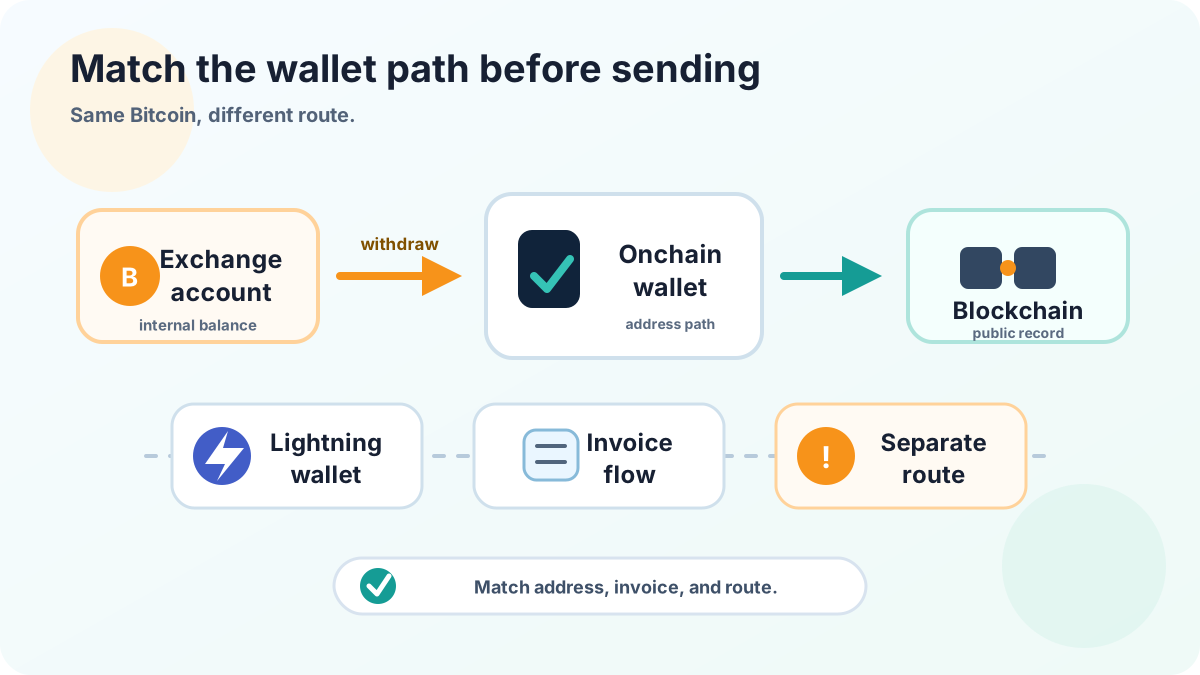
Exchange balances, on-chain wallets, and Lightning payments are different paths.
The exchange account is like a balance inside a building. The onchain wallet is more like holding the door key to your own little vault. That key gives you control, but it also gives you the job nobody can do for you: protecting the backup.
Onchain wallet vs. Lightning wallet
Lightning is a Bitcoin payment network, but a Lightning payment is not the same thing as a normal on-chain Bitcoin address payment.
That sentence is boring until you are staring at a withdrawal screen.
If one side gives you a Lightning invoice and the other side expects an on-chain Bitcoin address, the payment path does not match. If a platform asks you to choose a withdrawal method, the labels matter. The same habit that prevents picking the wrong network also helps here: match the sending path to the receiving instructions.
If a wallet says it supports Bitcoin, that still does not tell you whether the current receiving screen is for on-chain Bitcoin, Lightning, or both. Do not guess from the word "Bitcoin" alone.
Self-custody, private keys, and backup responsibility
Many onchain wallets are self-custody wallets. That means you, not an exchange account system, are responsible for the wallet backup and recovery path.
That can be powerful. It can also be unforgiving.
Self-custody is not a magic safety sticker. It is a responsibility transfer. The platform has less control over your funds, but you also have less room to blame a login screen if the backup is lost, the recovery phrase is exposed, or the wrong address is used.
The hot-or-cold question is a different layer. A hot wallet can use on-chain transactions, and a cold wallet can also use on-chain transactions when it signs and sends. Hot and cold describe how keys are stored; on-chain describes the transaction path.
Bitcoin.org's wallet guidance puts the responsibility on the user to choose and secure a wallet carefully. For beginners, the practical version is simple: do not move meaningful Bitcoin into a wallet until you understand how the wallet is backed up, how it can be restored, and what information must stay private.
Beginner checklist before using an onchain wallet
Before you withdraw, receive, or send Bitcoin with an onchain wallet, check the basics slowly.
You understand whether the current path is on-chain Bitcoin, Lightning, or an internal platform transfer.
The receiving screen gives you a Bitcoin on-chain address if you are making an on-chain withdrawal.
You know who controls the wallet backup.
You know where the recovery phrase or backup belongs, and where it should never go.
You understand that a wrong address or lost backup may not be fixable.
You can explain the difference between the exchange balance and the wallet balance.
You are not sending a large amount through a path you have never tested.
The point is not to become a protocol expert before touching a wallet. The point is to know which room you are standing in before you press the button.
FAQ
Is an onchain wallet the same as a Bitcoin wallet?
Not always. A Bitcoin wallet may support on-chain Bitcoin transactions, Lightning payments, or both, depending on the wallet design. "Onchain wallet" specifically points to the on-chain Bitcoin transaction path.
Is an exchange account an onchain wallet?
Usually no. An exchange account can show a Bitcoin balance, but it is still an account inside the platform until you withdraw to a wallet address. The platform's rules, limits, and account access still matter.
Does an onchain wallet mean I control my private keys?
Often, but not automatically. Many onchain wallets are self-custody wallets, but products can use wallet language in different ways. Check whether you control the backup, recovery phrase, or private keys before assuming.
Is an onchain wallet hot or cold?
It can be either. A hot wallet can support on-chain transactions, and a cold or hardware wallet can also send on-chain transactions. Hot and cold describe how keys are stored; on-chain describes the transaction path.
Is Lightning the same as on-chain Bitcoin?
No. Lightning is a Bitcoin payment network with a different payment flow. A Lightning invoice and an on-chain Bitcoin address should not be treated as interchangeable.
What should I check before withdrawing to an onchain wallet?
Check the receiving address, payment path, wallet backup, platform withdrawal screen, fees shown, and whether the wallet actually supports the type of Bitcoin transfer you are making.
Official References
Risk Disclaimer
This article is for beginner education only. It is not financial, investment, legal, tax, custody, or security advice. Bitcoin transactions can be irreversible, Bitcoin is volatile, and wallet mistakes can cause permanent loss. Wallet software, platform rules, withdrawal support, security features, and recovery processes can change. Check official wallet and platform documentation before acting, and use qualified professional help when needed.
Editorial Attribution
Written by Alex Chen. Reviewed by Jordan Blake for factual accuracy, clarity, and beginner safety.